



In-House Label Printing vs Outsourcing in Australia
Every Australian manufacturer, food and beverage brand owner, or label converter who relies on product labels eventually confronts the same decision: keep outsourcing to a trade printer, or bring label production in-house? The answer isn't obvious — and the wrong choice costs more than most businesses realise.
Label printing outsourcing in Australia remains the dominant model. With over 4,500 printing businesses operating across the country , a figure that grew 9.6% in 2024 alone according to IBISWorld ; there's no shortage of trade printers willing to quote your next label job. But dominant doesn't mean optimal. For a growing segment of Australian manufacturers and brand owners, the economics and operational realities of outsourcing are pushing them to reconsider.
This article provides a practical, numbers-grounded comparison of label printing outsourcing in Australia versus in-house digital label printing. It covers cost per label, minimum order quantities, turnaround times, compliance risk, total cost of ownership, and the hybrid model most Australian manufacturers quietly land on. The goal is an honest analysis , including the scenarios where outsourcing remains the right call ; so you can make a decision grounded in your actual volumes, SKU complexity, and operational requirements.

Prefer to talk it through? Call (03) 9318 7177. Gulmen Digital's team is in Ravenhall, VIC.
What Does Outsourcing Label Printing Involve?
In an outsourced model, you prepare artwork files and send them to a commercial or trade label printer. They handle prepress, colour management, production, finishing, and delivery. You receive finished label rolls, sheets, or fan-fold stock ready for application.
Australian trade printers operate across three main print technologies:
- Flexographic printing — high-speed, cost-competitive on large, stable runs; requires plate production, which adds setup cost and time

- Offset/litho — used for some sheeted and premium label formats
- Digital trade printing — suited to short and medium runs, personalisation, and variable data; no plates, but scheduling and minimum charges still apply
The practical appeal of outsourcing is straightforward. For a stable product with predictable volume, a trade printer's economies of scale are difficult to match with an in-house system. You pay per job, avoid capital expenditure, and access professional finishing capabilities , foiling, embossing, specialty substrates ; that are impractical to replicate internally for most businesses.
The pain points are equally real. Standard turnaround from Australian label printers typically runs five to ten business days, and rush jobs attract premium charges. Minimum order quantities exist because printers need to cover setup time, plate costs, and scheduling overhead. For businesses with short runs, seasonal SKUs, or frequent design changes, those MOQs force over-ordering — and any labels that become obsolete before they're used represent a direct write-off. When FSANZ regulations change, a supplier shifts an ingredient, or marketing decides to refresh a design, that warehouse stock becomes a liability overnight.
What Does In-House Label Printing Involve?
In-house label printing means owning a digital label printer , and optionally a label finisher ; and producing labels on demand from your own digital artwork files. You control the print queue, the timing, and the versioning. You print what you need, when you need it.
There are two meaningful tiers of in-house equipment:
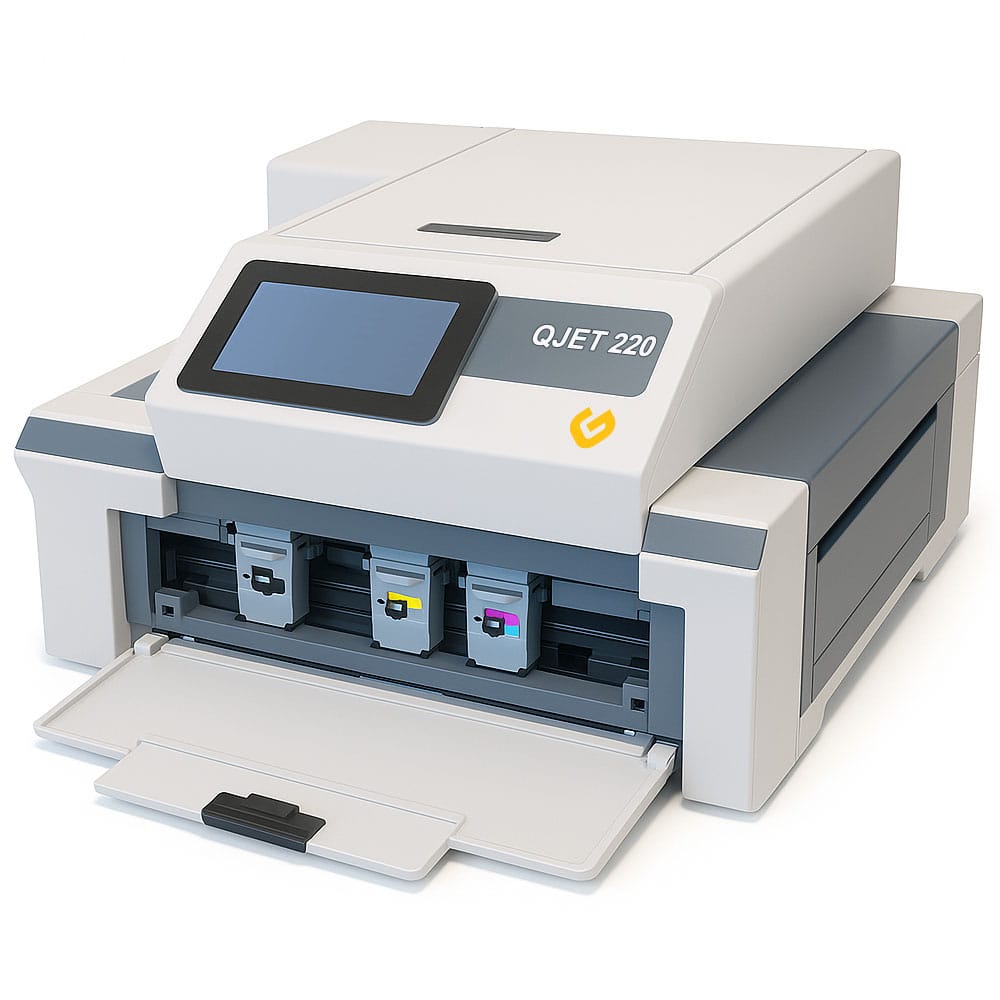
Entry-level commercial label printers are inkjet or toner-based systems suited to smaller businesses, growing food and beverage brands, and operations where flexibility matters more than raw volume. They handle short runs across many SKUs with minimal setup per job and a lower upfront cost. If you're deciding between inkjet and toner technology for your application, see Gulmen Digital's guide on inkjet vs toner label printers for a detailed comparison of print quality, media compatibility, and running costs.
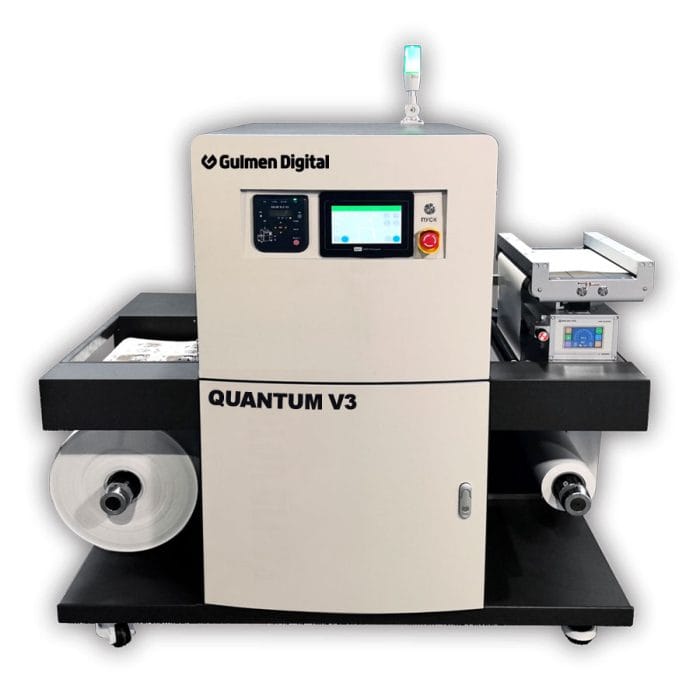
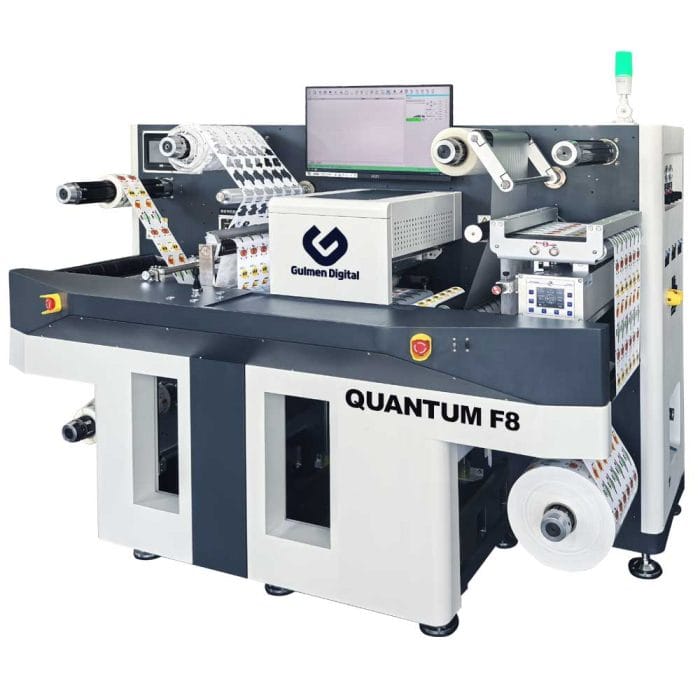
Industrial digital label presses are production-grade systems designed for higher duty cycles, wider web widths, and continuous operation. They're the appropriate choice for larger manufacturers, label converters, and businesses with substantial monthly label volumes across demanding substrates. These systems are often paired with inline or nearline finishing equipment for lamination, die-cutting, and slitting.
In practical terms, an in-house setup runs like this: artwork files are maintained in a controlled digital workflow, a roll of blank label stock is loaded, and labels are printed in precisely the quantity needed for the current production run. Batch codes, expiry dates, and serial numbers are handled as variable data — no incremental setup cost per variant, no waiting for a new proof approval. When a formulation changes or a regulatory update takes effect, you update the artwork file and reprint the next batch the same day.
Australia's print label market was valued at approximately USD 1.44 billion in 2025 and is projected to grow at a CAGR of 3.16% through 2034, according to IMARC Group. Within that growth, digital printing is taking share from conventional methods — driven by shorter runs and faster change cycles.
Cost Comparison — Outsourcing vs In-House Label Printing in Australia
Cost is the question most buyers ask first. The honest answer is that it depends on volume and variety — and that most cost comparisons undercount what outsourcing genuinely costs.
Direct comparison
Hardware and setup costs for in-house printing
Entry-level digital colour label printers suitable for commercial use in Australia generally start from around $2,500–$5,000+ AUD, depending on print width, duty cycle, and ink technology. Industrial digital label presses represent a significantly higher investment, scaled to monthly volumes and finishing requirements. Adding a label finisher , laminator, die-cutter, slitter ; increases upfront cost but unlocks considerably more capability, including the ability to produce professionally finished roll labels from blank stock.
The hidden cost of outsourcing
The per-label quote from a trade printer is only part of the picture. A realistic cost comparison must also include freight across Australia, rush fees for urgent jobs, the cost of maintaining label stock across multiple SKUs, and the write-off value of labels scrapped due to compliance changes or rebrands. For FSANZ-regulated food and beverage products, ingredient or nutritional changes can trigger immediate reprints — and any stock printed under the previous specification has zero residual value.
A practical starting point: pull your last 12 months of label invoices and add freight, rush charges, and any obsolete stock write-offs. That total is your true annual label spend — the baseline any in-house investment needs to beat or justify over a three-to-five-year horizon.
Break-even logic
At very high volumes with a small number of stable SKUs, outsourcing to a flexo or digital trade printer almost always produces a lower unit cost. The trade printer's capital and throughput are working in your favour.
The calculus shifts at shorter run lengths and higher SKU counts. When you have dozens of active label designs, some running only a few hundred units at a time, the MOQs and setup fees embedded in outsourced pricing inflate the real cost per usable label substantially. In-house digital printing carries no MOQ — the cost per label is determined by ink and media consumption, not minimum batch economics.
At moderate monthly volumes spread across many SKUs — a pattern that describes a large share of Australian food and beverage manufacturers — in-house systems can achieve payback within one to three years, based on avoided MOQ waste, freight, and rush charges alone.
When Does Outsourcing Label Printing Make Sense?
Outsourcing remains the right model for a clearly defined set of scenarios. Acknowledging that matters — credibility comes from honest comparison, not from overstating the case for in-house production.
- High-volume, stable SKUs. If you produce large quantities of the same label design with minimal changes over time, trade printers running high-speed flexo or offset presses will deliver a lower unit cost than any in-house system. Their capital is sized for this workload; yours probably shouldn't be.
- Specialist finishes and substrates. Cold foil, hot foil, embossing, tactile varnish, metallised films, and extreme-environment synthetics are most cost-effectively produced by specialist label converters with purpose-built finishing lines. For premium brand work where these finishes define the product presentation, outsourcing is often the only practical path.
- Limited capital or operational capacity. Not every business is ready to take on equipment ownership, media management, and print operations. If capital expenditure is constrained or there's simply no internal capacity to manage a printer, outsourcing keeps labelling as an operating expense with no operational overhead.
- Infrequent, low-urgency needs. A business that only occasionally needs labels, can tolerate standard lead times, and has no urgent compliance requirements may find outsourcing simpler and cheaper than any in-house alternative.
When Does In-House Label Printing Make Sense?
In-house label printing earns its keep when your pain points are about agility and control rather than volume. The businesses that benefit most share a common profile: many SKUs, frequent changes, tight timelines, and meaningful compliance risk.
- Frequent label changes. Seasonal products, promotional campaigns, recipe updates, and regulatory revisions all drive label changes. Each change under an outsourced model requires a new order cycle, new proofs, and often a rush fee. In-house printing makes artwork changes a non-event — update the file, load the stock, reprint.
- Short to medium runs across multiple SKUs. For businesses with dozens or hundreds of active label designs, the economics of outsourcing deteriorate quickly. MOQs force over-ordering on every SKU, and a proportion of that stock is inevitably wasted. In-house digital printing eliminates the minimum order entirely.
- Variable data requirements. Batch codes, expiry dates, lot numbers, and serialised barcodes can be embedded directly into digital label artwork and printed with no incremental cost per variant. This is one of the clearest advantages of digital in-house production for manufacturers with traceability requirements.
- FSANZ compliance in food and beverage. Australian food and beverage manufacturers operate under FSANZ standards that govern ingredient declarations, nutritional panels, allergen statements, and country-of-origin labelling. Regulatory updates can require immediate label changes. In-house digital printing means those changes happen on your schedule — not a trade printer's production calendar. For a detailed breakdown of what FSANZ requires on product labels, see Gulmen Digital's guide on food label compliance in Australia.
- Industrial and safety labelling. Manufacturers dealing with hazardous materials, safety data requirements, or standards-based certification labelling carry real compliance and liability risk from outdated labels. The ability to update and reprint immediately is not just operationally convenient — it manages risk.
- Supply chain independence. A growing number of Australian manufacturers cite supply chain resilience as a driver of in-house investment decisions. When a delayed label shipment can halt a production line, the operational value of same-day printing extends well beyond cost per label.
The Hybrid Approach — What Most Australian Manufacturers Do
In practice, the decision is rarely binary. A substantial portion of Australian manufacturers run a hybrid model that draws on both outsourcing and in-house production, matching the method to the job.
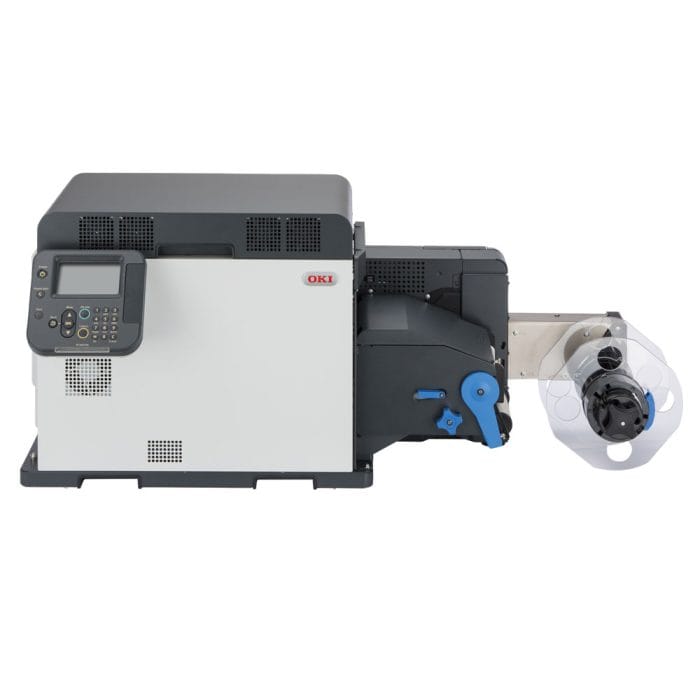
The most common pattern is straightforward: large-volume, brand-heavy base labels with complex finishes go to specialist converters. Variable data , batch codes, dates, regulatory statements, promotional overprints ; gets added in-house using a digital label printer. This preserves the cost advantage of trade printing on stable, high-volume work while eliminating the delay and inflexibility of outsourcing variable content.
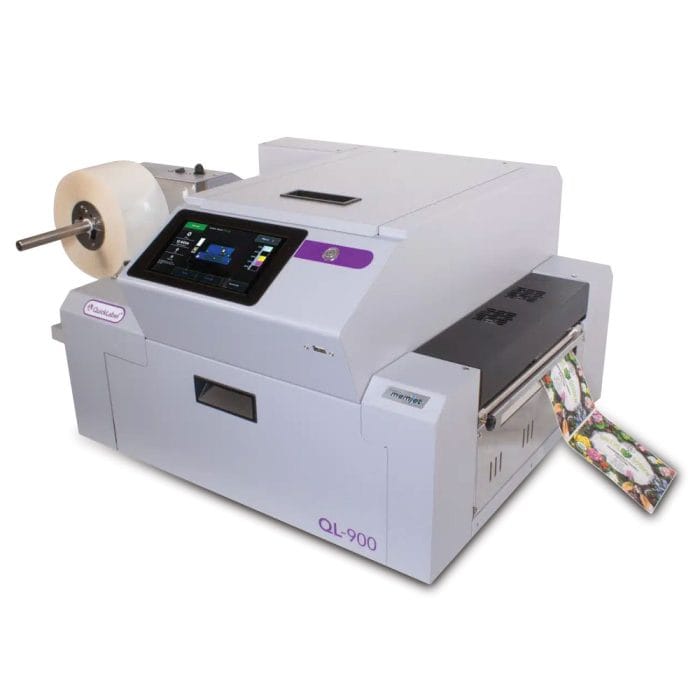
A second approach uses in-house digital printing for short-run and urgent jobs while routing main production through outsourced channels. When a new SKU launches, a seasonal variant is introduced, or an urgent replacement is needed, the in-house printer handles it. When a large, predictable run of a core product label is due, the trade printer handles it.
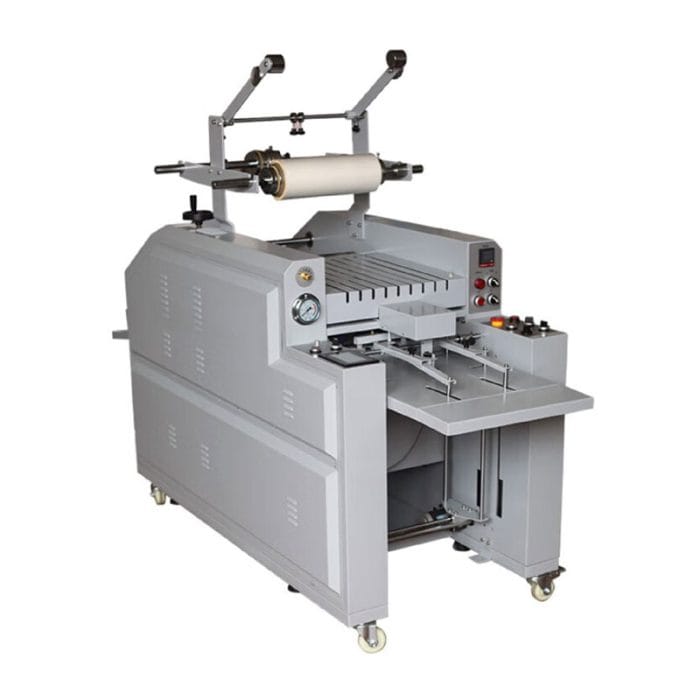
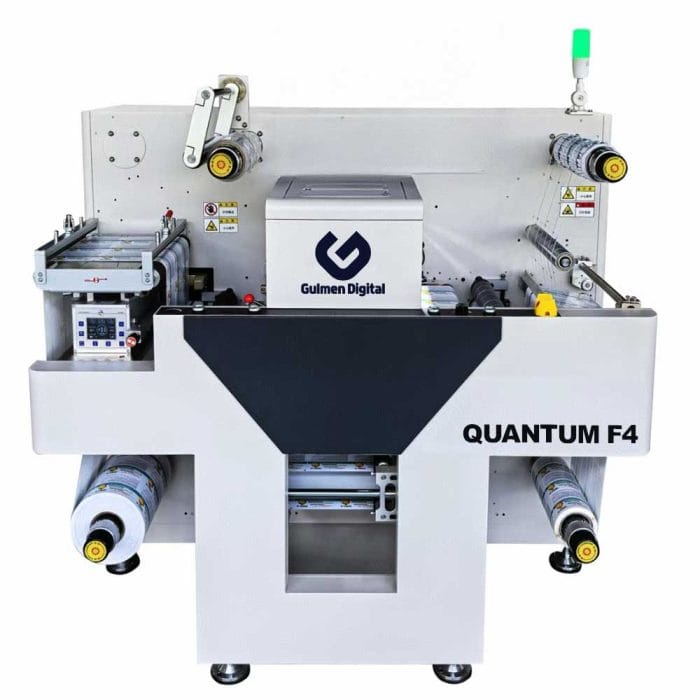
A third configuration uses in-house finishing equipment , laminator, die-cutter, slitter ; to convert outsourced pre-printed webs or in-house printed stock into finished labels. This can reduce dependence on external finishing schedules and improve format flexibility without requiring a full production press.
For more detail on how hybrid configurations can be structured and what equipment combinations make sense at different volume levels, see Gulmen Digital's article on alternatives to outsourcing label printing.
The hybrid model is pragmatic for a reason: it allows businesses to phase capital investment. Start with a mid-range digital printer for the SKUs and run lengths that benefit most from in-house production. Add finishing capability as volumes and complexity grow. Scale to a production-tier press when the economics justify it. No single capital decision needs to cover the entire operation.
Choosing the Right In-House Label Printing Setup for Your Business
If in-house or hybrid label printing is worth pursuing for your operation, the relevant question is which system matches your actual workflow — not which system has the most features.
- Assess your volumes and SKU profile first. Total monthly label output matters, but the distribution across SKUs matters more. A business printing 50,000 labels per month across 200 active designs has a different hardware requirement than one printing the same volume across five designs. High SKU counts and frequent changes favour digital systems; high volume on stable designs favours production-tier equipment.
- Clarify your substrate and finishing requirements. The materials you need to print on , paper, polypropylene, polyester, specialty films ; and whether you need lamination, die-cutting, or matrix removal in-house will significantly shape both the printer and finisher selection. Not all digital label printers handle all substrates equally well.
- Match the equipment tier to your operation. Entry-level commercial systems are the right starting point for most SMEs, growing food and beverage brands, and businesses moving short-run jobs in-house for the first time. Industrial production presses are appropriate when monthly volume and utilisation justify the capital — typically for label converters and larger manufacturers integrating digital capability into an existing production environment. For a detailed guide to matching hardware to operational requirements, see Gulmen Digital's label printer guide for Australian manufacturers, and for a comparison of digital versus conventional print technologies, see digital label printing vs traditional.
- Gulmen Digital specialises in commercial and industrial label printing and finishing equipment for the Australian market. As a locally based supplier, the team can model cost and workflow scenarios against your actual label spend, SKU count, and compliance requirements — helping you identify whether in-house, outsourcing, or a hybrid configuration delivers the best long-term value. Explore the full equipment range at Gulmen Digital label printers when you're ready to assess specific systems.
Next Steps for Australian Manufacturers and Brand Owners
Australia's printed label market is growing, and the businesses best placed to manage that growth are those with clear control over their label production — whether through well-managed outsourcing, a calibrated in-house setup, or a hybrid of both.
The decision comes down to four variables: your annual label volume, the number of active SKUs and how frequently they change, your compliance obligations, and your appetite for capital investment. Get those four numbers clear, and the right model becomes considerably easier to identify.
Australian manufacturers and brand owners evaluating their label printing setup are encouraged to contact Gulmen Digital to discuss their specific volume, SKU count, and finishing requirements — and to determine the right balance between in-house capability and outsourced label printing for their business.

Prefer to talk it through? Call (03) 9318 7177. Gulmen Digital's team is in Ravenhall, VIC.
FAQ — In-House vs Outsourced Label Printing in Australia
Is it cheaper to print labels in-house or outsource in Australia?
At high volumes with stable SKUs, outsourcing to a trade printer is typically cheaper per label due to economies of scale. For short runs, frequent artwork changes, or multiple SKUs, in-house printing is generally more cost-effective once you account for MOQs, freight, rush fees, and obsolete stock write-offs.
The break-even point depends on your specific volume and SKU profile, but businesses printing across many designs at short run lengths often find in-house systems pay back within one to three years.
What is the minimum investment to set up in-house label printing?
Entry-level digital colour label printers suitable for commercial use in Australia start from approximately $2,500–$5,000+ AUD, depending on print width and technology. Industrial production presses carry a higher capital cost suited to larger volumes.
A complete setup including a label finisher varies based on finishing requirements and throughput targets. Gulmen Digital can provide a cost model based on your actual volumes.
How long does it take to get labels from an outsourced printer in Australia?
Standard turnaround from Australian trade label printers is typically five to ten business days, not including freight. Rush options are available but usually attract premium pricing and depend on external production schedules. In-house printing produces labels same-day or within hours, limited only by your own workflow.
Can I print compliant food labels in-house?
Yes. Modern digital label printers produce high-resolution labels that meet FSANZ standards when paired with appropriate substrates and inks. In-house printing can improve compliance management because you can update artwork immediately when regulations or formulations change, without waiting for an external print run or risking non-compliant stock in the warehouse.
What is the difference between a label printer and a label press?
A label printer typically refers to a desktop or entry-level commercial device designed for lower volumes and standard label formats. A label press refers to an industrial production machine , digital or flexographic ; designed for high-throughput commercial printing.
Label presses are what trade converters use, and what larger manufacturers bring in-house when volume and duty cycle justify the investment.
Do I need a finisher as well as a printer?
Not necessarily at the outset. Many businesses begin with a printer and use pre-cut blank rolls or sheets matched to their format requirements. A label finisher , laminator, die-cutter, slitter ; significantly improves label durability, professional presentation, and format flexibility. Most operations add finishing capability as volumes and complexity grow rather than committing to the full setup from day one.



Comments ()