
Coffee Bag Label Printing: Get It Right First Time

Meta description: From material choice to minimum runs — everything roasters need to know about coffee bag label printing. Compare methods, finishes & suppliers in one guide.
Most roasters choose a label material based on what looks good rather than what survives the job — and that single mistake explains why labels peel, bubble, and smear before the coffee reaches a customer's hands. Coffee bag label printing means producing adhesive labels that you apply to pre-made pouches or bags, distinct from having artwork printed directly onto the packaging film itself, and the decision framework covers four interlocking choices: print method, material, finish, and minimum quantity. Get those four right and everything downstream — cost, turnaround, durability, compliance — falls into place.
 Gulmen Digital
What Coffee Bag Label Printing Means in Practice
Coffee bag label printing produces pressure-sensitive adhesive labels that stick to flexible packaging such as stand-up pouches, flat-bottom bags, or side-gusset kraft bags. The bag itself stays blank or carries only a generic brand colour; the label does all the branding and legal work. That approach gives roasters enormous flexibility — change a single-origin offering, update a roast date, or launch a limited edition without scrapping an entire bag inventory.
Two fundamental routes exist. The first is in-house printing using a dedicated coffee label printer, typically a thermal transfer or colour inkjet device; loaded with blank label stock. The second is outsourced printing, where a trade or online supplier produces rolls or sheets of finished labels via digital or flexographic presses.
Before choosing either route, every roaster must settle three decisions:
- Material — paper, BOPP, kraft, or foil
- Finish — matte, gloss, soft-touch, or metallic
- Minimum quantity — which determines whether digital, flexo, or in-house printing delivers the best unit economics
These three decisions cascade into adhesive type, printer compatibility, lead time, and reorder strategy. The rest of this guide works through each in sequence.
Choosing the Right Label Material and Finish
Paper, BOPP, kraft, and foil
BOPP (biaxially oriented polypropylene) is the default for most specialty coffee labels. It resists moisture, tears less easily than paper, and handles the oils that migrate through coffee bag walls without scuffing or lifting. For roasters whose bags move through warm, humid warehouses or café storerooms, BOPP with a matte or gloss laminate is the most reliable combination.
Paper costs less and prints cleanly on both inkjet and laser desktop printers, but it is vulnerable to grease and condensation. An uncoated paper label on a full bag of dark roast will often show oil bleed within weeks — exactly when it is sitting on a café shelf in front of a customer.
Kraft and uncoated paper deliver the artisan aesthetic that specialty coffee branding often demands, but they need a protective varnish or clear laminate to resist coffee-oil migration and handling scuffs. Without that protection, they look great on day one and tired by week three.
Foil labels — whether metallic substrate or foil-stamped — create strong shelf impact and work well for premium whole-bean retail lines and gift products. The trade-off is cost and design complexity: foil stock requires tighter file preparation and usually sits at the higher end of per-label pricing.
Matte, gloss, soft-touch, and metallic finishes
A matte finish reduces glare, reads cleanly under café and retail lighting, and suits the minimalist design language common in specialty coffee. A gloss finish makes colours saturate and pop — particularly useful for vibrant origin photography or illustration-led branding. Soft-touch laminate is the finish gaining fastest traction in specialty coffee in 2026: it adds a velvety, tactile quality that signals premium positioning the moment a customer picks up the bag, without requiring a louder graphic treatment. Metallic finishes and spot varnishes work best when used selectively — a foil-stamped logo mark on a matte bag reads as deliberate and refined; an entirely metallic label often reads as busy.
Adhesive types
Permanent adhesive is standard for almost every coffee bag application. Labels need to survive filling, transport, stacking, and a shelf life of several months without lifting at the corners. Removable adhesive suits temporary promotions, sample packs, or reusable canisters where a clean peel-off matters. Freezer-grade adhesive is only necessary when bags enter cold storage or refrigerated retail displays — standard adhesives fail under condensation cycling.
One compatibility check that most guides skip: the adhesive must match your specific pouch film. PET-foil laminates, kraft-poly composites, and compostable films each behave differently. A label that adheres perfectly on one pouch can peel within days on another. Request adhesive datasheets from your supplier and test on actual filled bags before committing to a production run.
Print Methods Compared: Digital, Flexo, Thermal, and Online
Digital printing
Digital label printing transfers artwork directly from file to stock without plates. That makes it ideal for roasters who rotate single-origin offerings, print variable roast dates, or produce multiple SKUs from a single run. The global label market reached an estimated US$44.8 billion in 2024, with digital's share rising to 21.6% by value — driven precisely by demand for shorter, more customised runs. For coffee, digital becomes economical from around 50 to 2,000 labels per design, supports full-colour artwork with no setup charge, and typically delivers in 3–5 business days from an approved proof.
Flexographic printing
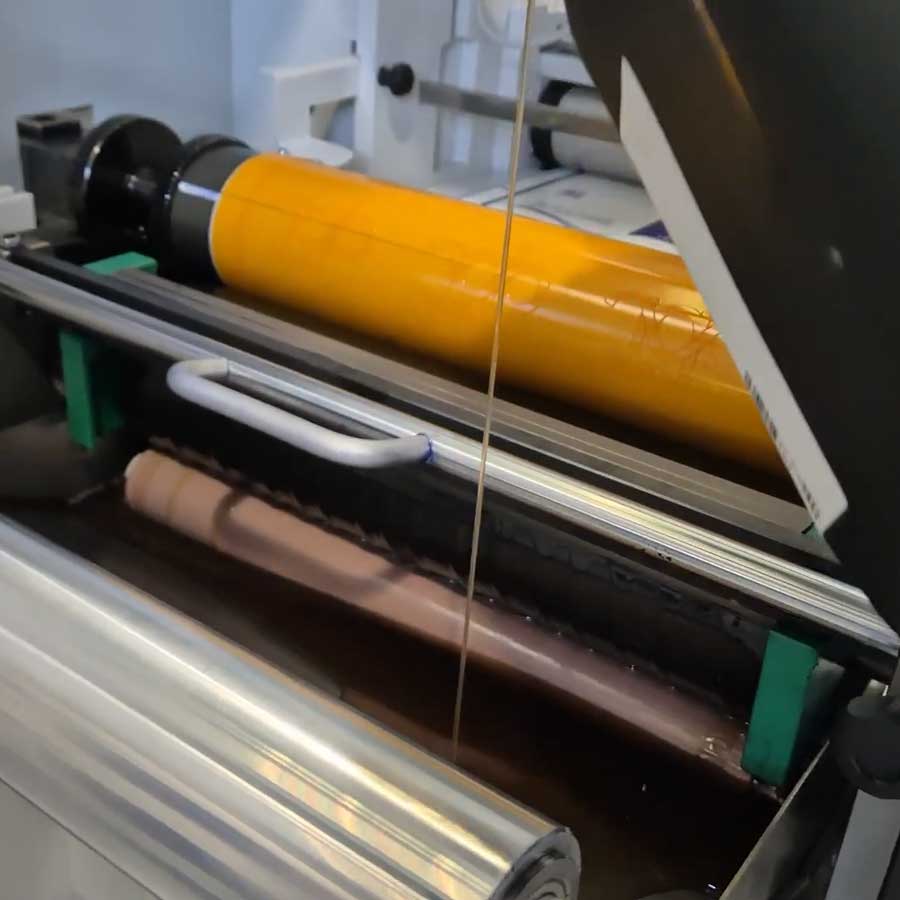
Flexo uses physical plates to transfer ink, which means an upfront plate cost, typically $150–$600 per colour; that only makes economic sense when spread across large volumes. At 5,000+ labels, flexo unit costs drop sharply, often below $0.05 per label for standard sizes on roll stock. The trade-off is lead time (7–14 days including plate-making) and inflexibility when artwork needs to change. Flexo suits wholesale or supermarket-facing roasters whose core SKUs run long and stable.
Industry data shows flexo still accounts for 39.6% of world label output by volume, making it the backbone of high-run label production globally. For specialty coffee, however, most roasters never reach the volumes where that infrastructure makes sense.
In-house coffee label printers
Devices like the Epson ColorWorks series and similar colour inkjet label printers let roasters print finished labels on demand, same day, with no minimum order. This suits weekly small-batch releases, private-label jobs, event customisation, and subscription bags where origin changes frequently. Thermal transfer units handle barcodes and variable text exceptionally well but are usually limited to one or two colours — better for logistics labelling than brand-led packaging. A colour inkjet printer on blank BOPP rolls gives full creative flexibility; the trade-off is hardware cost, ink management, and the need to maintain colour consistency in-house.
Online print-on-demand platforms
Online suppliers — including local Australian equivalents of Sticker Mule and similar services — let roasters upload artwork, choose size and material, and receive rolls or sheets within a few days. They work well for straightforward orders, but watch three things before submitting:
- Bleed requirements (typically 2–3 mm)
- Colour mode (CMYK, not RGB)
- Adhesive compatibility with your specific pouch film
Convenience is real; assume nothing about material performance.
 Gulmen Digital
Minimum Orders, Unit Costs, and Scaling for Roasters
| Volume | Best approach | Typical unit cost |
|---|---|---|
| Under 200 labels | In-house or print-on-demand | Lowest total cost once plate fees and shipping are excluded |
| 500–2,000 labels | Digital printing | $0.15–$0.50 per label depending on size and material |
| 5,000+ labels | Flexographic printing | Often below $0.05 per label on roll stock |
The micro-roaster zone, under 200 labels per design; is where in-house printing or print-on-demand wins almost every time. Maximum flexibility, minimum sunk cost per SKU. The 500–2,000 range is the digital sweet spot: no plates, full colour, professional finishes, and unit costs that work for a growing roaster with a stable brand identity across a handful of core SKUs. At 5,000+, get quotes with and without laminate, because finish accounts for a larger share of unit cost than most roasters expect at this scale. Roll stock on an applicator further reduces labour cost per bag.
Regardless of volume, order 10–15% overage on every run. Application errors, damaged bags, QC failures, and sample requirements consume more labels than roasters anticipate. A small buffer is cheaper than a rush reorder at premium pricing.
Label Design Requirements and Food Compliance
Australia
Australian coffee labels must carry the product name, net weight in grams, country of origin, supplier's Australian street address, and an allergen statement if applicable. A best-before or roast date is strongly expected by retailers and increasingly mandated by direct sales platforms. Country-of-origin claims require particular care — see the next section.
United States
Under FDA rules, plain roasted coffee (whole bean or ground, no additives) is generally exempt from the Nutrition Facts panel. Labels still require a statement of identity, net quantity in both US customary and metric units, and the name and address of the manufacturer, packer, or distributor. Any flavouring or additive triggers an ingredient list and potential allergen disclosure.
File specifications
Submit artwork as a print-ready PDF at 300 DPI minimum, in CMYK colour mode, with 3 mm bleed on all edges and fonts converted to outlines. Keep critical text and barcodes at least 2–3 mm inside the trim line. Follow your supplier's preflight checklist and always request a digital soft-proof or physical proof before approving a full production run. A proof costs almost nothing; a reprint costs real money.
Canva, Adobe Express, and Affinity Publisher handle most design jobs accessibly. Adobe Illustrator remains the trade standard for final production artwork, particularly when spot colours, die lines, or complex vector work are involved.
Coffee Bag Label Printing in Australia: Local Considerations
For coffee roaster labels Australia, the practical question is speed versus cost. Local Australian suppliers typically offer 3–5 day turnaround for digital runs, easier proofing communication, and adhesive recommendations matched to locally sourced bag films. Offshore production, predominantly China-sourced; can reduce label cost by 30–50% at volume, but adds 3–6 weeks of lead time once freight and customs are included. That arithmetic breaks down fast when you rotate single origins every few weeks.
Australian Consumer Law requires country-of-origin statements to meet specific percentage thresholds. "Product of Australia" requires that the food was substantially grown and processed domestically. "Packed in Australia from imported coffee" is the correct statement for beans sourced overseas and roasted locally. Misusing "made in Australia" when beans are imported is a common — and enforceable — compliance mistake.
Australian specialty café buyers increasingly favour suppliers whose packaging aligns with sustainability values. Recycled-content face stocks, water-based adhesives, and FSC-certified paper labels are all gaining traction. The practical caution: sustainable materials still need to perform. A compostable label on the wrong pouch film will peel in a humid warehouse before the bags reach a café, which defeats both the environmental intent and the brand impression.
Finally, check adhesive compatibility with your specific pouch film supplier. Australian warehouses run hot and humid — conditions that expose adhesive mismatches that would be invisible in a temperate climate. A small test batch on actual filled bags, stored under realistic conditions for one to two weeks, is the cheapest form of quality control available.
Gulmen DigitalFAQ
What is the best label material for coffee bags? BOPP is the strongest all-round choice for specialty coffee because it resists moisture, tearing, and oil migration while holding full-colour print cleanly. Kraft paper works well for an artisan aesthetic but needs a protective laminate or varnish to survive grease contact and humid storage. Match the material to your specific bag film and test adhesion before ordering a full run.
How much does it cost to print coffee bag labels in small quantities? For runs under about 200 labels, in-house printing or print-on-demand platforms are usually most cost-effective once setup and shipping are included. In the digital sweet spot of 500–2,000 labels, expect roughly $0.15–$0.50 per label depending on size, material, and finish — with no plate fees to absorb. Always compare total cost, including proofing and freight, not just the quoted per-label price.
Can I print my own coffee bag labels at home? Yes. A desktop colour inkjet label printer loaded with blank BOPP or paper roll stock lets micro-roasters print on demand with no minimum order and same-day turnaround. The trade-offs are hardware cost, ongoing ink expense, and the discipline required to maintain colour consistency. For roasters who change roast dates or single origins weekly, in-house printing often beats waiting on supplier lead times.
What information is legally required on a coffee bag label in Australia? Australian coffee labels generally need the product name, net weight in grams, a country-of-origin statement, the supplier's Australian street address, and an allergen statement if applicable. A best-before or roast date is strongly expected by retailers. Country-of-origin wording must meet Australian Consumer Law thresholds — "Packed in Australia from imported coffee" is correct for imported beans roasted locally.
What file format and resolution do I need to submit for coffee bag label printing? Submit a print-ready PDF at 300 DPI minimum, in CMYK colour mode, with 3 mm bleed on all edges and fonts converted to outlines. Keep text and barcodes within a safe zone at least 2–3 mm inside the trim line. Request a digital soft-proof before approving production — catching a colour shift or misaligned die line at proof stage costs nothing compared to reprinting an entire run.

Comments ()