



Alternatives to Outsourcing Label Printing: Options for Manufacturers
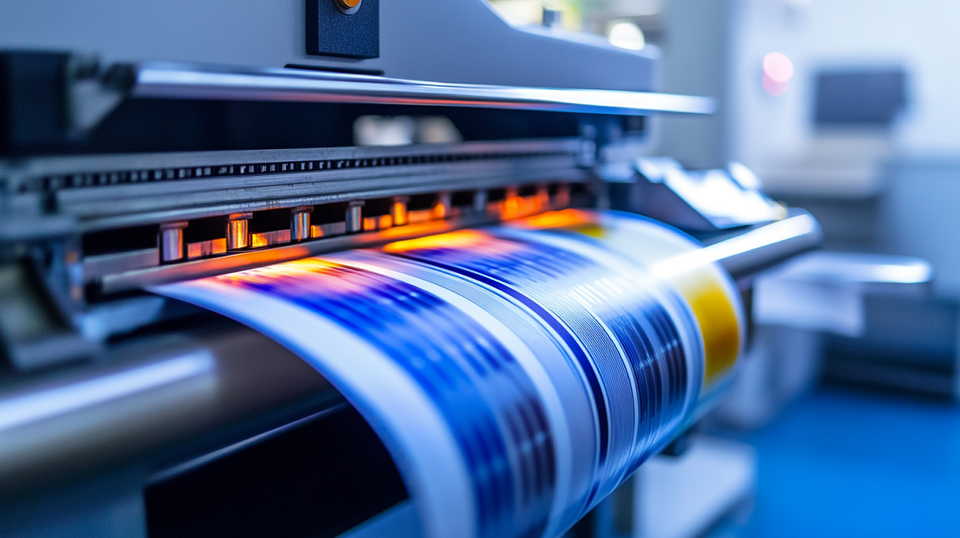
Most Australian manufacturers don't leave outsourced label printing because they want to become printers. They leave because they've waited three weeks for a label update, written off a pallet of obsolete stock after a regulatory change, or paid a rush premium that wiped out the margin on a short production run. The machinery has improved enough that bringing label production in-house — or closer to it — is now a realistic option for SMEs with 5 to 200 staff, not just large-scale converters.
This guide sets out four practical alternatives to outsourcing label printing for Australian manufacturers, with a direct comparison of costs, lead times, and operational fit.
The limitations of outsourced label printing
Long lead times and minimum order quantities
External label converters run shared presses on batch schedules. Your job queues alongside other customers' jobs and gets slotted in when it fits the press plan — not when your production line needs it. Standard turnaround times of 5–10 working days from artwork approval are common across Australian and UK suppliers, and that's before you add interstate freight.
The structural reason is minimum order quantities. Converters set MOQs , often 5,000 to 10,000 labels per SKU ; to recover setup time and press changeover costs. For manufacturers with 20, 50, or 100 active SKUs, hitting that minimum on every variant means ordering far more labels than current demand justifies. The unit economics look attractive on paper; the cash flow and storage reality is far less so.
High cost per label at small volumes
Outsourced label pricing is built around long runs. Setup charges, plate or tooling costs (for flexographic jobs), proofing rounds, and administration overhead are fixed costs that get spread across the print quantity. At 1,000 labels per SKU, those fixed costs dominate. At 20,000 labels, they become negligible. That pricing curve is the converter's business model — it is not designed to serve a manufacturer with frequent short runs across many variants.
In-house digital systems invert this logic. No plates, no tooling, no queue to join — switching between SKUs costs almost nothing operationally. The fixed cost is the machine; the variable cost is ink and media. For manufacturers producing tens of thousands of labels per month across a mixed SKU portfolio, this structure consistently delivers a lower cost per usable label than outsourcing, once waste and rush fees are factored in.
Inflexibility for artwork changes and new SKUs
Every artwork change with an external supplier triggers a new cycle: revised file, new proof, approval sign-off, updated quote, scheduling into the next available press slot. For regulatory updates — allergen declarations, GHS hazard statements, Country of Origin changes, updated nutritional panels — that cycle adds weeks to a compliance task that should take hours.
The same friction applies to new product launches. If a food manufacturer wants to test three flavour variants before committing to a full production run, outsourced MOQs force an uncomfortable choice: over-order and hope the trial succeeds, or pay a steep per-label premium for small proof runs. In-house digital production removes that constraint entirely.
The variable data label printing segment , batch codes, serialisation, version-specific fields ; is growing at 13.6% CAGR globally through 2030, driven largely by manufacturers solving exactly this problem.
Stock write-offs from obsolete labels
Pre-printed label inventory carries a hidden liability. Any change to a product , formulation, packaging size, branding hierarchy, regulatory requirement ; can make thousands of labels unsaleable overnight. A specialty food producer holding six weeks of pre-printed stock across 30 SKUs carries material write-off risk on every product update.
Industry research confirms that moving from forecast-driven overruns to on-demand replenishment typically trims obsolete label stock by 15–25% for active SKUs — and for manufacturers with frequent seasonal or limited-edition variants, the elimination can be close to total.

Prefer to talk it through? Call (03) 9318 7177. Gulmen Digital's team is in Ravenhall, VIC.
Four alternatives to outsourcing label printing
Alternative 1 : In-house digital label printing
On-demand printing for multiple SKUs
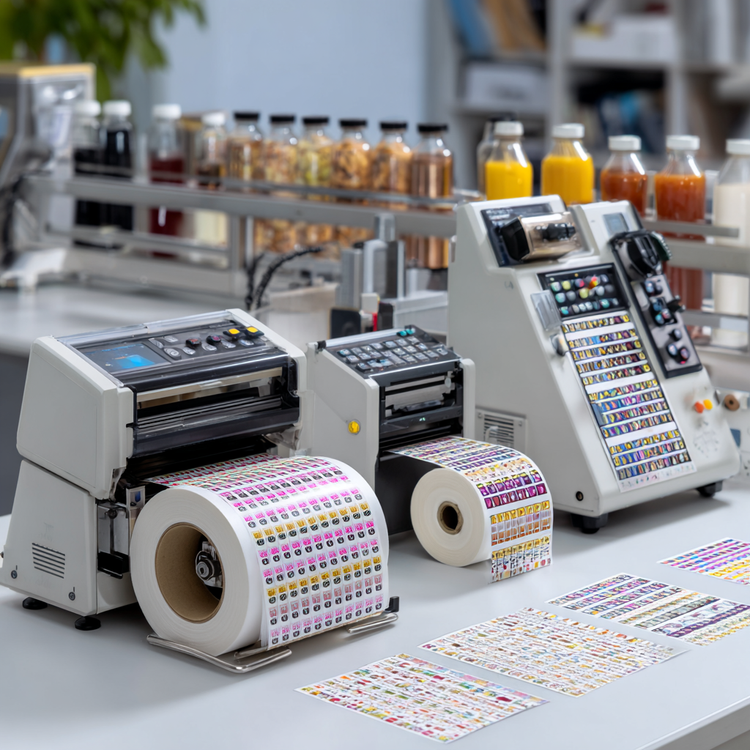
Industrial digital label presses print directly from a digital file to media — no plates, no tooling, no scheduling queue. Switching between SKUs is a file change. A manufacturer with 60 active SKUs can run a different label every few metres without stopping the press or adjusting tooling, making short, frequent runs economical in a way that outsourced flexo production never can be.
The operational benefits compound quickly.
- Labels are printed hours before they're applied, not weeks before they're needed. Compliance changes go live in the next print job.
- Seasonal variants and retailer-specific SKUs carry no MOQ penalty.
- Label inventory shrinks from pallets to a manageable roll or two per product line because you print only what you need.
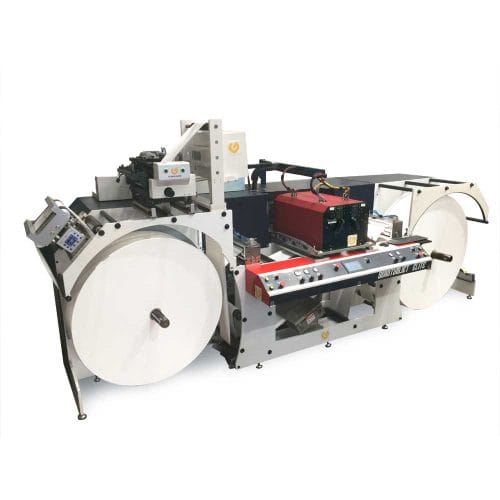
The Quantumjet Elite from Gulmen Digital: an Australian-made solution
For in-house label printing in Australia, a locally built and supported system offers advantages that go beyond the machine itself. The Quantumjet Elite from Gulmen Digital is an industrial digital label press engineered for the SME manufacturing environment — short to mid-run production, high SKU counts, and production staff rather than professional press operators.
- Spare parts arrive in days, not months.
- Technical support runs on Australian business hours.
- Installation and training happen on-site,in your facility.
For a manufacturer whose labelling line sits on the critical path of production, uptime and serviceability aren't secondary considerations — they determine whether the investment works. Gulmen Digital supplies the Quantumjet Elite as part of an end-to-end workflow that includes finishing integration, making it a production asset rather than a standalone device.
Industrial digital in-house printing delivers the strongest return where SKU counts are high and artwork changes are frequent. That profile maps directly onto four sectors:
Food & beverage: Flavour variants, seasonal labels, retailer-specific barcodes, and ongoing nutritional compliance all benefit from on-demand printing. Print Digital Solutions identifies food and beverage as a primary beneficiary of in-house digital label capability.
Cosmetics and personal care: High SKU counts, frequent reformulations, ingredient and claims updates, and retail shelf aesthetics make digital the natural fit. Short runs per SKU are the norm, not the exception.
Chemicals and cleaning products: GHS pictograms, hazard statements, safety data, and multilingual requirements can all change with little notice. In-house production means compliance updates don't wait for a converter's schedule.
Industrial and B2B goods: Serialisation, customer-specific branding, OEM variants, and small-batch production runs are all better served by a digital system with no minimum quantity than by an external supplier with a 5,000-label floor.
Alternative 2 : Hybrid digital + flexo in-house lines
How hybrid systems work
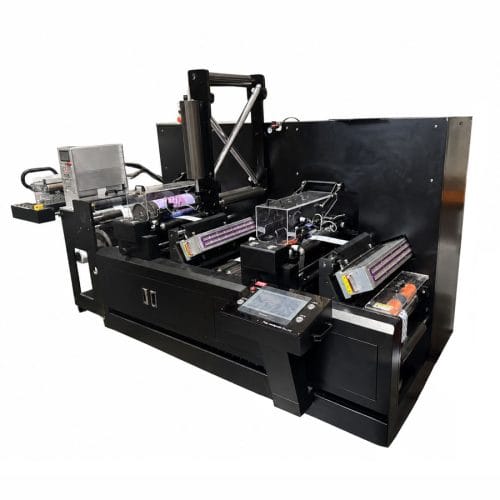
A hybrid line integrates flexographic print units with a digital engine on a single web path. Flexo stations handle solid colours, opaque whites, and varnish layers — the repeating, high-coverage elements that flexo does efficiently at speed. The digital module handles the variable and SKU-specific elements: graphics, variable data, versioned copy, barcodes. Downstream finishing — die-cutting, laminating, slitting — runs inline.
The result is a press that handles both long-run workhorse labels and short-run variants within a single workflow, rather than routing each to a different process or supplier.
Speed and quality benefits (up to 70 m/min in hybrid configuration)
Hybrid configurations run at production speeds up to around 70 m/min in mixed digital and flexo modes — significantly faster than most standalone digital systems on sustained runs. For manufacturers with high aggregate label volumes across a mixed portfolio, that throughput makes hybrid a credible full replacement for external converters rather than a supplement to them.
Quality in hybrid configuration is typically superior to standalone digital for labels with heavy opaque whites, metallic flexo inks, or specific spot colours that fall outside digital gamut. The flexo units deliver those elements with consistency at speed; the digital module contributes the variable and short-run graphic elements without plates.
When hybrid makes sense vs pure digital
Hybrid makes commercial sense when a meaningful proportion of your volume consists of long-run, stable labels that benefit from flexo economics — and you want to consolidate both that volume and your short-run variant work onto one line. If 60–70% of your annual label production is a handful of high-volume SKUs with occasional variants, hybrid lets you capture the economics of both modes without splitting your supply chain.
For most Australian SMEs entering in-house label production for the first time, a pure industrial digital press is the better starting point. Lower capital cost, simpler operation, and no plate management make it a more manageable transition. Hybrid becomes relevant once you've established an in-house workflow and volumes have grown to justify the additional investment and complexity.
Alternative 3 : Desktop and mid-range label printers
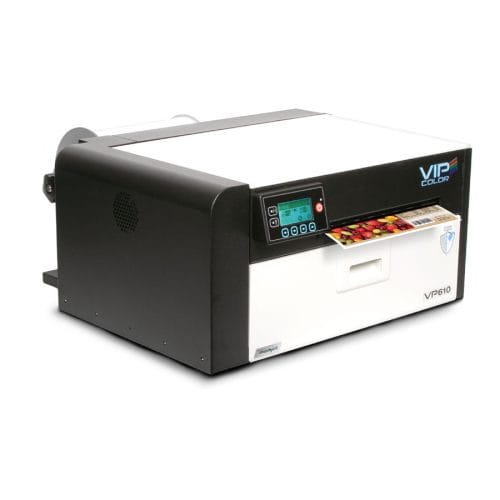
When desktop is sufficient (low volume, simple labels)
Desktop and mid-range colour label printers , small thermal transfer or inkjet units ; have a legitimate place for low-volume, low-complexity applications. Shipping labels, internal warehouse identification, basic product stickers for trial runs, and emergency backup printing are all within scope.
For very small print jobs, in-house desktop printing avoids minimum order charges entirely and allows variable fields — batch numbers, dates — to be added on demand, making it cost-effective at micro-volumes where outsourced MOQs would otherwise force over-ordering. For a manufacturer validating a new product before committing to a full production setup, a desktop device removes the MOQ barrier entirely.
Limitations vs industrial systems
Desktop systems have hard ceilings. Print speeds are low, duty cycles are limited, and substrate compatibility is narrow. Colour consistency , critical for brand-colour accuracy across production batches ; is harder to maintain on lower-end devices. Colour consistency across production batches — critical for brand-colour accuracy — is harder to maintain on lower-end desktop devices, a limitation well documented across industry reviews of entry-level inkjet label printers.
Running costs per label are also higher at medium and large volumes than industrial systems, because ink and media costs per unit don't scale the same way. Desktop is a useful tactical tool; it is not a production solution for a manufacturer with meaningful ongoing label demand across multiple SKUs.
Alternative 4 : Shared or contract in-plant printing
A shared or contract in-plant model places printing capability physically at or near your facility without requiring full capital ownership. Typical structures include a label equipment provider installing and operating a press within your facility on a cost-per-label or minimum-volume contract, or several manufacturers in an industrial precinct sharing access to a centrally located press.
The model reduces freight time and cost , labels are produced locally rather than shipped interstate ; while lowering the capital and operational burden compared with owning and running a press yourself. For Australian manufacturers in regional locations, or those with insufficient volume to justify full equipment ownership, this approach can deliver the lead-time and flexibility benefits of in-house production without the full investment.
The tradeoff is control. A third party operating on or near your site introduces dependency on their scheduling, quality standards, and commercial terms. Contractual clarity on uptime, quality specifications, and data confidentiality for private-label SKUs is essential before committing to this arrangement.
Cost and ROI comparison: outsourcing vs each alternative
Total label cost includes more than the per-label price. Setup fees, minimum order charges, freight, rush premiums, and the annualised cost of obsolete stock write-offs all belong in the calculation. When those factors are included, in-house digital solutions frequently deliver break-even within one to three years for manufacturers with meaningful annual label spend.
The table below provides a directional comparison. Values are indicative and will vary by volume, substrate, artwork complexity, and Australian input costs.
The table below provides a comparison of the different label printing solutions discussed:
How to choose the right alternative for your business
The decision comes down to four variables: annual label volume, SKU count and change frequency, compliance risk, and capital availability.
Start with your current pain. Pull 12 months of label invoices. Add freight costs, rush charges, and any write-offs from obsolete labels. That number is your baseline — the annual cost your alternative needs to beat or justify over a three-year horizon.
Map your SKU profile. If you have 10 SKUs that rarely change and run in large quantities, outsourcing may still be competitive, or a simple desktop device covers your occasional short-run needs. If you have 30-plus active SKUs with regular artwork changes, in-house industrial digital is almost certainly cheaper on a total-cost basis once you account for MOQs and waste.
Assess compliance risk. Manufacturers in food, chemicals, or regulated health products face a specific exposure: a compliance update that makes existing labels non-compliant overnight. If that's your environment, the ability to update and reprint same-day is not a convenience — it's a risk-management requirement. In-house digital resolves this; outsourcing leaves you exposed to the lead-time gap.
Consider capital and internal capability together. A desktop device requires minimal investment and minimal training. An industrial digital press requires capital investment and staff capable of operating light industrial equipment and managing artwork files. A hybrid line requires more of both. Match the solution to what your operation can genuinely absorb in the first 90 days, then scale from there.
For most Australian SMEs in food, cosmetics, chemicals, or industrial goods , running multiple SKUs with regular changes and a meaningful annual label spend — an industrial digital press delivers the best balance of investment, flexibility, and operational control.
Gulmen Digital provides site assessments and ROI modelling based on your actual label volumes, which is the most direct way to validate the numbers before committing.
What is the cheapest alternative to outsourcing labels?
For very low volumes and simple labels, a desktop label printer carries the lowest upfront cost and eliminates MOQ charges and freight. For manufacturers producing thousands of labels per month across multiple SKUs, an industrial digital press typically delivers a lower cost per usable label than outsourcing over time — particularly once you account for reduced waste, eliminated rush fees, and avoided write-offs on obsolete stock.
How quickly can I implement in-house label printing?
Desktop systems are operational within days. Industrial digital presses typically require several weeks from order to full production, covering delivery, installation, operator training, and initial workflow integration. Most manufacturers run a phased rollout , starting with a defined subset of SKUs, then expanding ; which lets the operation build capability without disrupting current production. Once installed, in-house systems deliver same-day turnaround on label changes versus the 5–10 day cycles typical of outsourced suppliers.
What is the ROI on an in-house label printer?
ROI varies by volume, SKU profile, and current spend. Vendor analyses and independent print cost studies consistently show payback periods of one to three years for industrial digital presses at moderate-to-high utilisation, driven by lower per-label costs on short runs, reduced obsolescence write-offs, and the elimination of rush premiums. The most reliable way to calculate your specific payback is to model your last 12 months of label spend against the projected running cost of an in-house system at your current and forecast volumes.
Do I need a special room or setup for in-house label printing?
Desktop and mid-range printers require only a clean, dry space with standard power. Industrial digital presses need adequate floor space for the press and media rolls, a stable power supply, and basic environmental control — temperature and humidity within normal factory ranges. Most are designed to operate in production or packing areas rather than dedicated pressrooms. Specific requirements vary by system; Gulmen Digital provides site readiness guidance as part of the installation process.
What industries benefit most from in-house label printing in Australia?
Industries with high SKU counts, frequent artwork changes, and compliance-sensitive label content see the strongest returns. Food and beverage, cosmetics and personal care, nutraceuticals, chemicals and cleaning products, and industrial components all share this profile. In these sectors, the combination of shorter lead times, zero MOQs, and same-day compliance updates makes in-house label printing a production advantage, not just a cost-reduction measure.

Comments ()