
Label Finishing Machines in Australia: Laminating, Die-Cutting and Slitting
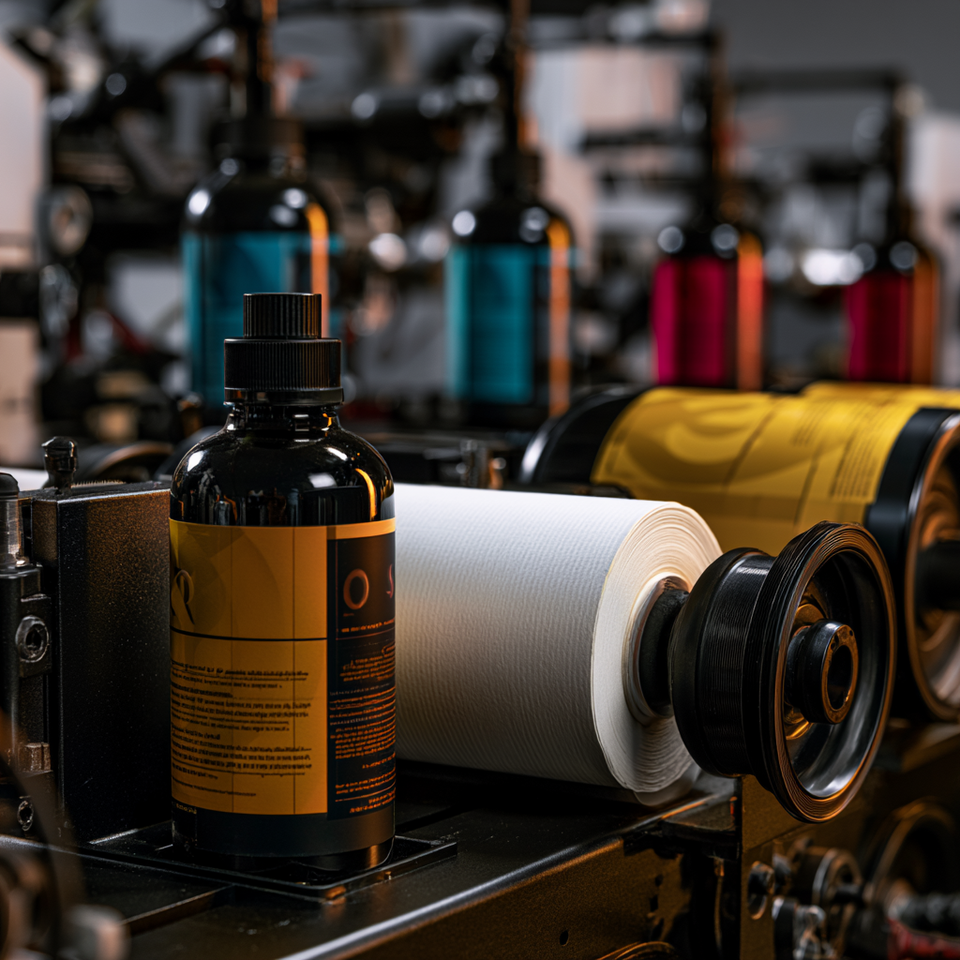
Most label operations treat finishing as an afterthought — something to sort out once the printer is running. That instinct is backwards, and it is costing Australian converters real money. The finishing stage is where a printed roll either becomes a commercially useful product or becomes a source of rework, delays and margin erosion. Getting it right means specifying finishing alongside your printer, not after it.
This article explains what label finishing covers, when bringing it in-house makes commercial sense, and how to match a finishing machine to your production output.

Prefer to talk it through? Call (03) 9318 7177. Gulmen Digital's team is in Ravenhall, VIC.
What Label Finishing Covers
A printed roll is not a finished label. Before it can run on an automatic labeller, ship to a customer, or go onto a product, it typically needs four things done to it: laminating, die-cutting, slitting and rewinding.
Laminating applies a clear film over the printed face. That film serves two purposes: protection and presentation. For labels exposed to moisture, handling, chemical contact or outdoor conditions , think food and beverage, industrial, cleaning products ; lamination is what keeps the print intact over the product's service life. It also controls the surface aesthetic, whether that means high-gloss, matte, or soft-touch.
Die-cutting gives a label its final shape. The die cuts through the face stock and adhesive while leaving the liner intact, so the label peels and applies cleanly. Kiss-cutting , where the cut goes through to just above the liner ; is the standard for pressure-sensitive self-adhesive labels. Some jobs also require perforations, sequential cuts, or full-cut sections, depending on the application.
Slitting divides a wide printed web into narrower finished rolls. A 330 mm printed web might need to become four 80 mm rolls for a customer running a multi-head labeller, or it might need to be split into different widths for different SKUs. Slitting handles that conversion in a single pass.
Rewinding collects the finished, slit labels onto cores in the correct format , the right outer diameter, core size, and wind direction ; so the rolls run cleanly on the customer's application equipment. This step is more critical than it sounds. A roll wound to the wrong outer diameter or incorrect wind direction causes misfeeds and line stoppages downstream.
 Gulmen Digital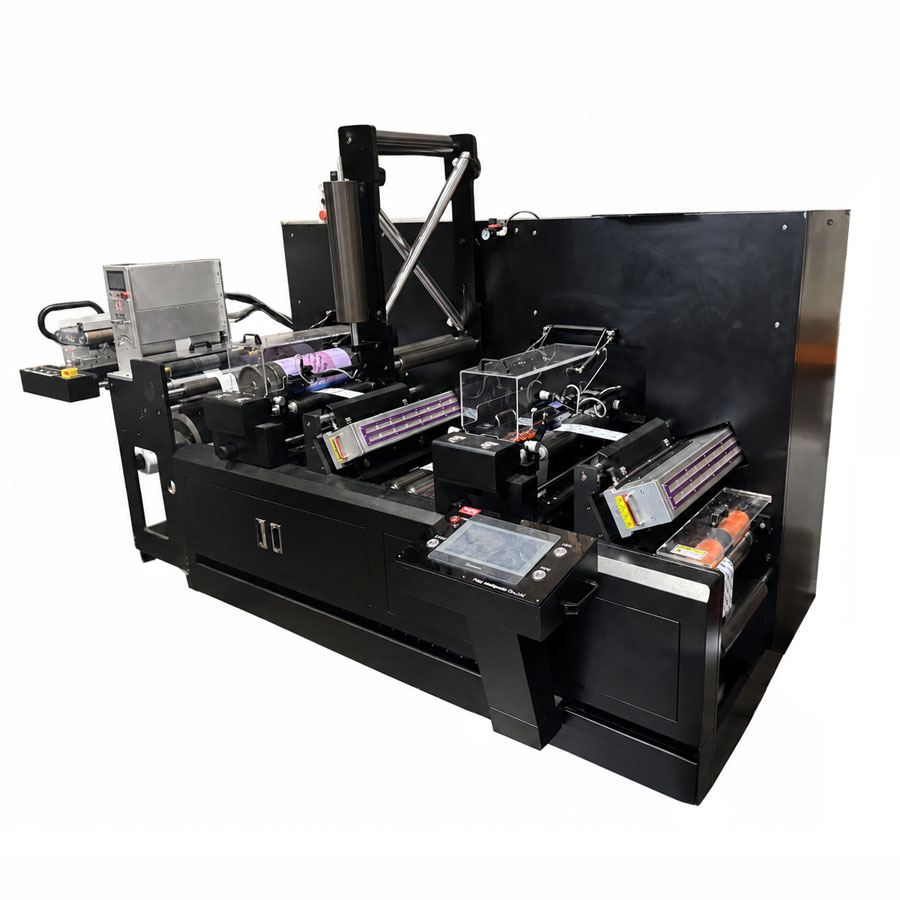
GD QuantumFlex Hybrid
A system like the GD QuantumFlex finishing line combines these processes into a single web path, converting printed roll stock into ready-to-apply label rolls without manual handling between steps.
When In-House Finishing Pays Off
The question is not whether finishing adds value — it always does. The question is whether in-house finishing adds more value than outsourcing it.
For many Australian converters and manufacturers, the answer shifts decisively towards in-house once one or more of these conditions apply:
- You are regularly waiting on an external finisher before you can dispatch jobs.
- You are paying freight and handling charges that erode your margin on shorter runs.
- Your customers require specific roll configurations , core size, outer diameter, wind direction ; that an outside finisher does not always get right.
- You print multiple SKUs with different shapes, laminates or roll formats, and each handoff to an external supplier creates a coordination overhead.
- You need to respond quickly to urgent reprints or seasonal volume spikes without depending on a third party's schedule.
Australia's print label market reached USD 1.44 billion in 2025 and is forecast to grow to USD 1.94 billion by 2034, driven in part by shorter runs, more SKUs and faster product cycles. That trajectory favours operations that can turn around finished labels quickly and flexibly — which is exactly what in-house finishing supports.
The calculus changes once you map your outsourcing spend against the capital and running cost of a finisher matched to your volumes. For many converters running a mid-range digital press at consistent utilisation, the payback period on an in-house finishing line sits inside three years , sometimes well inside it; once freight, rework, delay costs and lost margin on rush fees are included in the comparison.
Matching a Finishing Machine to Your Output
Buying the wrong finisher is as costly as not buying one at all. A machine that is undersized becomes a production bottleneck. One that is oversized ties up capital and depreciates without delivering proportional value. The matching process should start with your job profile, not with a machine specification sheet.
Define your web width and substrate mix first
Your finisher must handle the full web width of your printer output. If your digital press runs a 330 mm web, your finishing line needs to match that width without compromise. Substrate mix matters too: coated papers, BOPP films, clear-on-clear synthetics and specialist label stocks all behave differently under lamination and die-cutting. Confirm compatibility before you commit.
Match finishing speed to printer throughput
Your printer and finisher should be balanced. If the finisher cannot keep pace with printing output, you create a work-in-process backlog. If the finisher significantly outpaces the printer, you have spare capacity that is not earning its keep. The ideal configuration is one where the QuantumJet or QuantumJet Elite digital press and the finishing line are specified together, so throughput is balanced across the full workflow.
 Gulmen Digital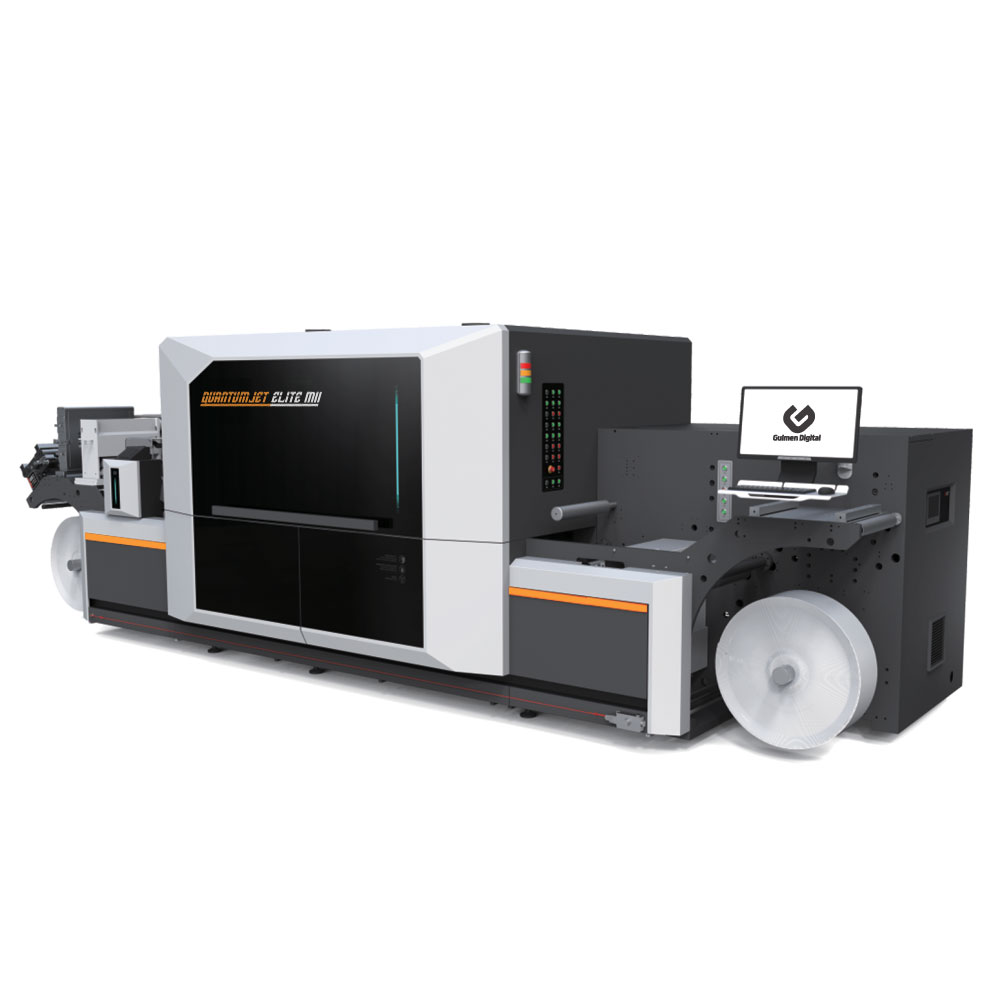
Account for changeover time, not just rated speed
Rated line speed figures are useful benchmarks, but real-world throughput depends heavily on changeover time between jobs. If you run 30 different SKUs per week with different shapes, laminates and roll formats, changeover efficiency matters as much as maximum speed. A finisher that takes two hours to set up for each new die eats into productive time faster than a slightly slower machine with streamlined changeovers.
Separate short-run digital from high-volume production
Short-run, high-mix digital environments and high-volume, low-SKU production environments have different finishing priorities. Short-run digital work needs fast changeovers, minimal tooling investment per shape, and the flexibility to run many different substrates in a single shift. High-volume production prioritises throughput consistency, roll-to-roll stability and durable tooling that holds tolerance across long runs. Be clear about which environment you operate in — or whether you need a finisher that can handle both.
Prefer to talk it through? Call (03) 9318 7177. Gulmen Digital's team is in Ravenhall, VIC.
Total Cost and Uptime: The Real Purchase Decision
Purchase price is the most visible cost. It is rarely the most important one.
The economics of a label finishing machine play out over three to five years, not at the point of sale. Over that period, the costs that determine your real return are consumables, waste, maintenance, operator time and downtime risk.
Waste is the cost driver most operations underestimate at the buying stage. Every web break, every mis-cut, every roll that fails to meet spec adds waste. A finisher with precise tension control, accurate registration sensors and stable die-cutting depth control reduces setup waste and in-run waste compared with one that needs constant manual adjustment. The difference compounds across thousands of production hours.
Consumables include lamination film, slitting blades, die tooling and cores. These costs are ongoing and should be factored into any total cost of ownership comparison. A machine that runs cheaper tooling but needs more frequent replacement may not be cheaper to operate than one with higher-cost but longer-lasting tooling.
Maintenance and uptime are where the argument for local support becomes concrete. A finishing line that stops because a spare part is on a three-week sea freight from overseas is not just an inconvenience — it can idle your printing operation and cost you customer commitments. Gulmen Digital's base in Maidstone, Victoria means service, parts and technical support are accessible for Australian operations without the lead times and logistical risk that come with overseas-sourced equipment support.
Operator labour is also part of the calculation. A finisher that requires minimal setup intervention and runs consistently with low operator overhead produces more usable output per labour hour than one that demands constant attention. Training time is a real cost too, and it matters when staff turn over.
Finishing and Print Quality: The Compliance Dimension
For Australian label converters supplying into food and beverage, industrial chemicals, healthcare or logistics, finishing quality is not just a production concern — it is a compliance concern.
Lamination that fails under refrigerated conditions, die-cuts that are misregistered on GHS-labelled chemical drums, or barcodes that scan inconsistently because print protection is inadequate — these are not just quality defects. They can create regulatory exposure for both the converter and the brand owner. A well-specified finishing line with reliable lamination, accurate registration and consistent die-cut depth helps ensure that finished labels meet the durability and legibility standards those industries require.
Frequently Asked Questions
What is the difference between a label printer, a label finishing machine and a labelling machine?
A label printer creates the printed web. A label finishing machine converts that printed web into finished label rolls — through laminating, die-cutting, slitting and rewinding. A labelling machine applies finished labels onto products or packaging. These are three separate stages in a label production workflow.
At what volume does in-house finishing start to make sense?
There is no universal threshold, because the answer depends on your SKU count, roll format requirements, outsourcing cost and dispatch requirements. The clearest indicator is when outsourcing finishing is regularly adding cost, delay or quality risk to your operation. Gulmen Digital can work through a tailored cost comparison based on your volumes and label mix.
Can a finishing machine handle different materials and shapes?
Yes — modern digital finishing lines such as the GD QuantumFlex are designed to handle a range of substrates including coated papers, BOPP films and synthetics, with die configurations or tooling to suit different label shapes and sizes. Confirming substrate compatibility for your specific mix is part of the specification process.
Should I specify a finisher at the same time as my printer?
Always. Specifying finishing after the printer is already installed creates the risk of a mismatch in web width, throughput or substrate handling that limits the performance of both machines. Specifying them together — as part of a complete QuantumJet or QuantumJet Elite plus GD QuantumFlex workflow — ensures the line is balanced from day one.
Talk to Gulmen Digital About Your Finishing Requirements
If your label operation is printing in-house but finishing through an external supplier , or if you are evaluating a new print-and-finish setup ; Gulmen Digital can help you work through the right configuration for your volumes, substrates and roll format requirements.
The Gulmen Digital team in Maidstone, Victoria works with Australian label manufacturers and converters to specify, install and support complete label production lines, including GD QuantumFlex finishing lines paired with QuantumJet and QuantumJet Elite digital label printers.
Book a demonstration or request a tailored quote, including a cost comparison against your current outsourcing spend ; by contacting Gulmen Digital directly. See the equipment running on your substrates, ask the hard questions about throughput and changeover, and get a clear picture of what in-house finishing would cost and return for your operation.
Prefer to talk it through? Call (03) 9318 7177. Gulmen Digital's team is in Ravenhall, VIC.


Comments ()