
Label Dispensers: Find the Right One Fast

Meta description: Manual, automatic, or wall-mount — compare every label dispenser type in one guide and buy the right one first time. Free shipping options available.
A label dispenser is not a peel-and-stick convenience item — it is the difference between a labelling workflow that scales and one that bottlenecks every operator who touches it. Strip away the jargon and the definition is precise: a label dispenser feeds pre-printed or blank labels from a roll one at a time, peeling the backing liner so each label is instantly ready to apply, without the operator fumbling with adhesive and paper between every pick.
That definition covers both manual dispensers, where the operator pulls the liner, and automatic label dispensers, where a sensor detects the moment a label is removed and a motor feeds the next one into position. Every product on this page works on that same mechanical principle. The right choice depends on your daily volume, label format, bench space, and whether you operate in a warehouse in Brisbane or a commercial kitchen in Fremantle.
 Gulmen Digital
What Is a Label Dispenser?
Core definition in plain language
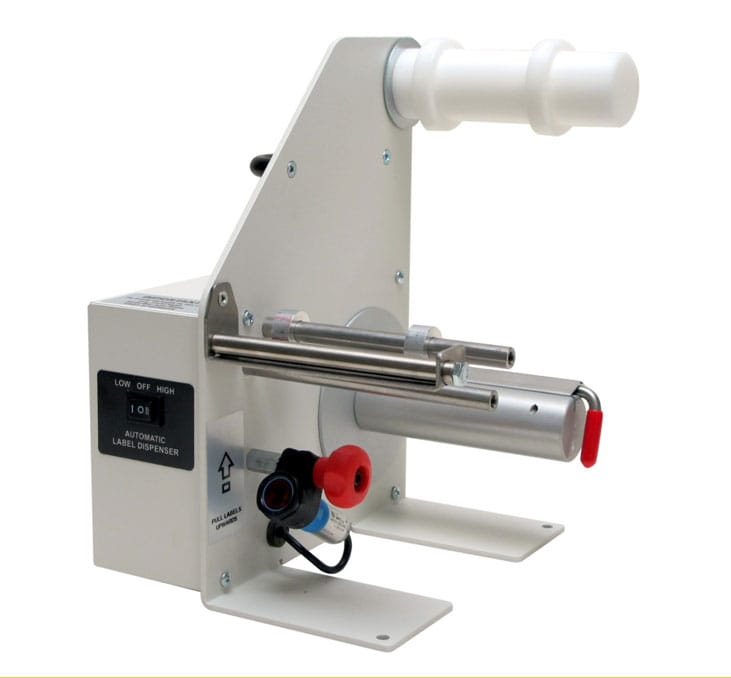
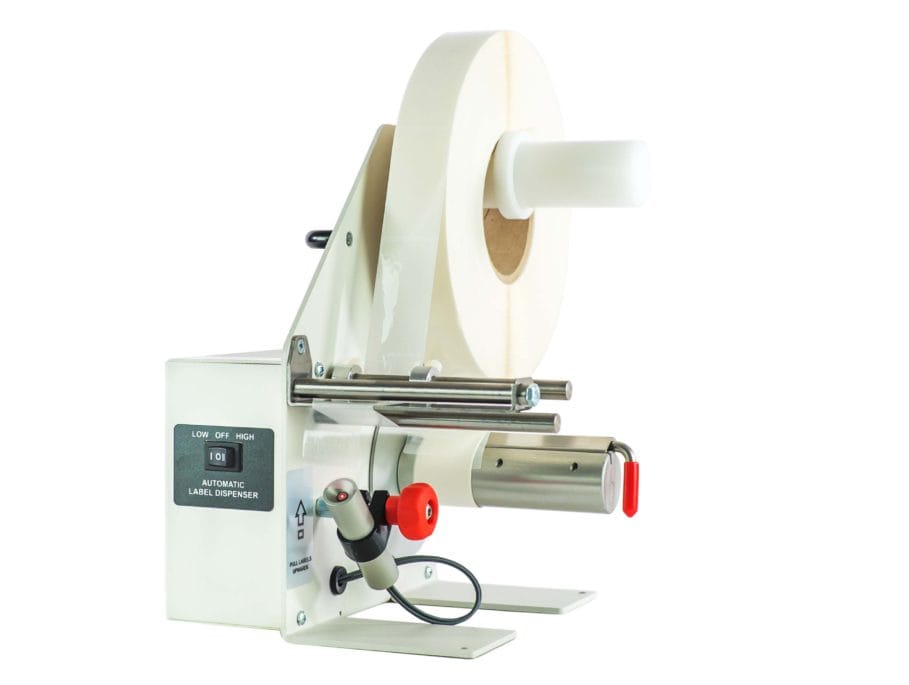
A label dispenser holds a roll of pressure-sensitive labels on a spindle and routes the liner over a sharp peel plate. As the liner bends around that edge, the label, being stiffer than the backing; continues forward and separates, leaving it projecting from the front of the machine ready to grab. The backing continues to a take-up reel or drops into a chute, keeping the workstation clear.
That mechanism answers the question directly: a label dispenser does not print, cut, or apply labels to products. It presents them. The operator still places each label by hand. That distinction matters when you are comparing products, because it separates dispensers from a related but different category of equipment entirely.
How a label dispenser works — step by step
- Mount the label roll on the spindle with labels unwinding in the direction the machine specifies — usually outward over the top.
- Thread the liner under guide rollers and over the peel plate, following the diagram on the machine.
- Advance the web until the first label protrudes from the peel edge, square and flat.
- The operator removes that label and places it on the product by hand.
- In a manual dispenser, pulling the liner or the label itself advances the roll and presents the next label.
- In an automatic label dispenser, a sensor, infrared or fibre-optic; detects that the label is gone and triggers the motor to feed the next one into position automatically.
The sensor-trigger step is what separates manual from automatic dispensers in practice. At low volumes, the difference in speed is modest. At several hundred labels per hour, the operator working with an automatic unit never stops moving, while the manual user pauses every cycle to pull.
Label dispenser vs label applicator: key difference
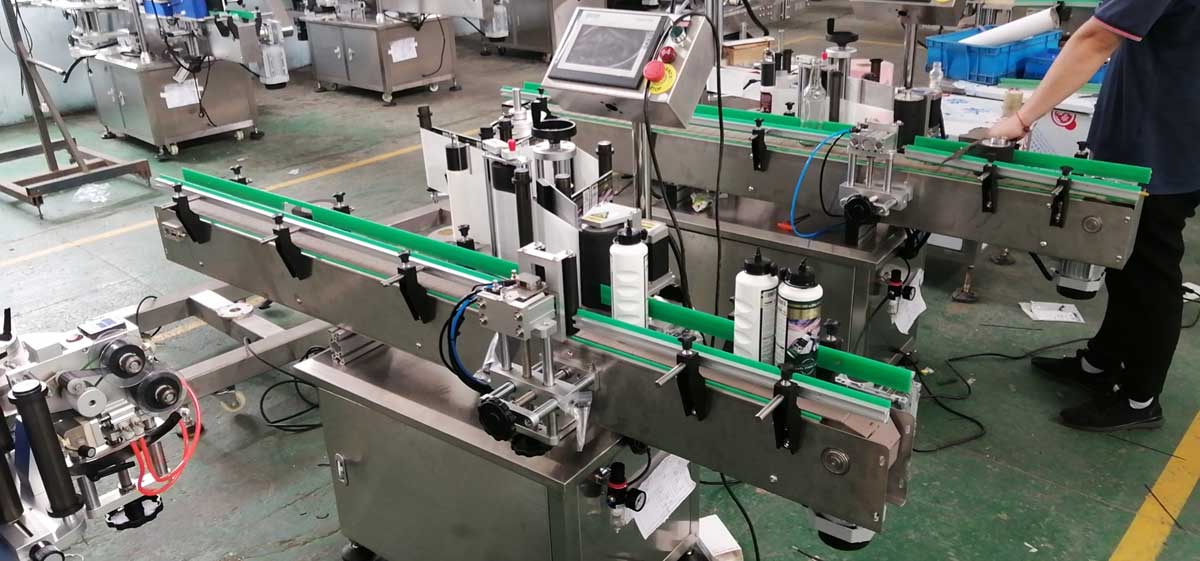
A label dispenser presents labels. A label applicator both presents and presses them onto the product surface using a roller, tamp pad, or wipe-on mechanism, often integrated into a conveyor line. Applicators suit high-volume, standardised production runs where label position must be exactly repeatable — bottling lines, carton-marking systems, and print-and-apply stations.
The print-and-apply labelling and equipment market sits at around USD 5.15 billion globally, reflecting how complex and capital-intensive full applicator systems are. For most businesses that need faster hand-application, a dispenser is the right starting point — not an applicator.
Types of Label Dispensers Compared
Most product pages treat this category in silos: one covers food-service rotation labels, another covers heavy-duty manual units for warehouses, a third covers shipping labels. No single page maps the full spectrum. Here it is.
Manual roll label dispensers
Manual dispensers are non-powered units with a spindle, guide roller, and peel plate. The operator pulls the backing by hand, and the next label pops forward. No motor, no sensor, no power outlet required.
These suit operations applying fewer than 200 labels per day — small e-commerce businesses packing occasional orders, clinics, offices, and artisan producers. Cost is low, maintenance is minimal, and the learning curve ends the moment the first roll is loaded. The trade-off is throughput: manual dispensers slow down any operator who needs to move at pace for more than an hour.
Automatic (electric) label dispensers
Automatic dispensers add a motor and a gap sensor. The sensor reads the space between labels on the roll. When it detects that the projecting label has been removed, because the sensor now sees the liner rather than the label; it closes the circuit, drives the motor, and feeds the next label until the sensor sees the new label's leading edge and stops.
Infrared sensors work reliably with opaque paper and synthetic labels, where there is strong contrast between the label and the liner. Fibre-optic sensors detect subtle thickness and transparency changes rather than colour contrast, making them the right choice for clear, metallic, or low-contrast labels. The automatic label dispenser market was valued at approximately USD 1.5 billion in 2024 and is projected to reach USD 2.9 billion by 2033 at around 8% CAGR — growth driven by operations that have found the productivity case for sensor-triggered dispensing compelling enough to justify the upfront cost difference over manual units.
Desktop vs wall-mount label dispensers
Desktop dispensers sit on a bench or packing table and move easily between stations. They suit offices, small warehouses, and e-commerce packing benches where operators work in one place but may need to reposition equipment.
Wall-mount dispensers fix to shelving uprights, wall brackets, or equipment frames. They clear the bench surface entirely, which matters in tight back-of-house retail environments, high-traffic warehouse packing lines, and any workstation where cartons, dockets, and tape guns already compete for space. The same motor and sensor technology available in desktop automatics applies to wall-mount units — mounting style is an ergonomic and spatial choice, not a performance trade-off.
Food-service clamshell label dispensers
Commercial kitchens need a different format. Food-service clamshell dispensers hold one or more small rolls of rotation labels, day-dot stickers, use-by labels, made-on labels; in a hinged plastic housing that sits on a prep bench or mounts to a shelving rail. The operator flips the clamshell open, pulls a label through the slit, and the roll advances. Labels are typically small, colour-coded by day of the week, and printed with date-coding fields rather than barcodes or shipping information.
This is a genuinely distinct category that generic search results tend to omit. For kitchens operating under food-safety and HACCP frameworks, the right clamshell dispenser, in a format that survives daily cleaning; matters as much as any warehouse unit.
Which type is right for your use case?
| Daily volume | Recommended type | Key benefit | Approx. Price range |
|---|---|---|---|
| Under 200 labels/day | Manual desktop dispenser | Lowest cost, no power needed | Low |
| 200–1,000 labels/day | Automatic desktop dispenser | Faster throughput, reduces fatigue | Mid |
| High volume, limited bench space | Wall-mount automatic dispenser | Clears work surface, efficient workflow | Mid–high |
| Commercial kitchen, rotation labels | Food-service clamshell dispenser | Hygienic, colour-coded, compact | Low–mid |
| Integrated production line | Automatic dispenser with applicator | Full label placement automation | High |
 Gulmen Digital
Key Buying Criteria for a Label Dispenser
Label roll width and core size compatibility
Before comparing any other specification, check whether the dispenser physically fits your existing label stock. Roll width determines whether your labels fit across the peel plate without curling at the edges or wandering off-centre. Many automatic units handle up to 110–115 mm (approximately 4.3–4.5 inches) in width. Core diameter — commonly 25 mm or 76 mm (1 inch or 3 inches) — must match the spindle. A roll that wobbles on an undersized spindle will feed inconsistently regardless of how good the sensor is.
Label material: paper, synthetic, clear
Paper labels are the simplest case — high contrast between label and liner, moderate stiffness, predictable peel behaviour. Synthetic labels (polypropylene, polyester) are more flexible and sometimes slicker, which affects tension through the liner path. Clear or transparent labels are the hardest case: standard infrared sensors cannot reliably detect the gap between a clear label and a clear liner because contrast is minimal. For clear labels, a fibre-optic sensor is not optional — it is the specification that determines whether the machine works at all with your stock.
Sensor type: fibre-optic vs infrared
Infrared sensors emit light and measure the return signal. A gap between labels returns a different signal than a label surface does, triggering the motor. This works well for opaque stock. Fibre-optic sensors use a thin optical fibre to deliver and receive light at a concentrated point, detecting changes in thickness or transparency that infrared cannot resolve.
If your operation handles mixed label types, opaque shipping labels and clear product labels on the same bench; a fibre-optic-equipped automatic dispenser handles both without recalibration between rolls.
Speed, duty cycle, and motor type
Speed is straightforward: match labels per minute to your operator's natural work pace. A dispenser that feeds faster than the operator can apply creates no advantage. Duty cycle — how long the unit runs continuously before requiring rest — matters more in sustained production environments than in burst-and-pause packing scenarios.
Motor type separates short-term from long-term cost. Brushed motors are cheaper to produce and therefore cheaper to buy, but the brushes wear over time and eventually require replacement or cause intermittent failures. Brushless motors cost more upfront and last significantly longer under heavy continuous use. In a warehouse dispensing thousands of labels per shift, the brushless motor's longer service life and lower maintenance frequency make the price difference rational within months.
Label dispenser considerations for Australian buyers
Australian workplaces run on 230 V / 50 Hz mains power. Many label dispensers are manufactured for North American 110 V / 60 Hz markets and require either a dual-voltage power supply or a transformer to operate safely in Australia. Confirm this specification before purchasing, particularly for automatic units sourced from international listings.
Australian label suppliers typically specify roll width and core diameter in millimetres. US-sourced product listings often use inches. The conversion is direct: 1 inch equals 25.4 mm, so a 4.5-inch maximum width is approximately 115 mm and a 3-inch core is 76 mm. Getting this wrong means the roll does not fit.
For label dispenser Australia buyers, local distributors that hold domestic inventory deliver in one to three business days to metro areas and provide warranty support without international freight complications. The Asia-Pacific labelling and coding equipment market was valued at approximately USD 1.5 billion in 2024 with above-average projected growth — which reflects meaningful local supply infrastructure worth using.
How to Set Up and Maintain Your Label Dispenser
Loading a label roll correctly
Place the roll on the spindle so labels unwind in the direction the manufacturer specifies — typically outward over the top. Thread the liner under any guide rollers, then over the peel plate, keeping light tension across the web. For automatic units, route the liner through tension bars and secure the tail. Advance 10–15 labels manually to confirm they emerge square and flat before returning the unit to production. A skewed label at setup predicts a skewed label at 500 cycles per day.
Adjusting the gap sensor for your label size
Incorrect gap-sensor calibration is the single most common cause of misfeed in automatic label dispensers — double-feeds, skipped labels, and inconsistent positioning all trace back to a sensor that is reading the wrong point on the web. Position the sensor so it reads directly over the gap between labels, not over the label surface or the middle of a printed area. Adjust sensitivity so the unit reliably detects each gap without false triggering on logos or dark print. Test with 20 consecutive labels at normal operating speed before calling the setup complete.
Routine cleaning to prevent misfeed
Adhesive residue builds up on peel plates and guide rollers. Dust and liner fragments accumulate around sensors. Both degrade performance over time. Wipe the peel plate and rollers with a lint-free cloth weekly in light-use environments and daily in high-volume ones. Clear the liner path of scraps after every roll change. Keep sensor lenses clean — a film of adhesive on an infrared sensor produces exactly the same symptom as a worn motor: inconsistent feed with no obvious mechanical cause.
 Gulmen Digital
FAQ
What is a label dispenser and how does it work?
A label dispenser holds a roll of pressure-sensitive labels and routes the liner over a sharp peel plate, causing each label to separate from the backing and project forward, ready to apply by hand. Manual units advance when the operator pulls the liner; automatic units use an infrared or fibre-optic sensor to detect when a label is removed and trigger a motor to feed the next one immediately. The result is faster, more consistent labelling without the repetitive fumbling of peeling labels individually.
What is the difference between a label dispenser and a label applicator?
A dispenser presents labels for a human operator to place by hand. An applicator both dispenses and presses the label onto the product surface using rollers, tamp pads, or wipe-on mechanisms — often integrated into conveyor or print-and-apply systems. Dispensers suit flexible, lower-volume workflows where an operator controls placement; applicators suit high-volume, standardised production where consistent label position on every unit is non-negotiable.
Which label dispenser should I use for shipping labels?
For occasional or low-volume shipping, a manual desktop dispenser handles the task at minimum cost. Once a packing station processes hundreds of labels per day or per shift, an automatic label dispenser, with infrared sensing for standard paper shipping labels; maintains operator pace and reduces repetitive-motion fatigue. In tight packing areas where bench space is scarce, a wall-mount automatic unit keeps labels accessible without displacing anything else on the workstation.
Can an automatic label dispenser handle clear or transparent labels?
Yes, but only if it is equipped with the right sensor. Standard infrared sensors struggle with clear labels because the contrast between a transparent label and a clear liner is insufficient to trigger reliable gap detection. An automatic dispenser fitted with a fibre-optic sensor detects the physical thickness change between label and gap rather than relying on contrast, and handles clear, metallic, and low-contrast labels accurately. Always confirm fibre-optic sensor support in the product specification before purchasing for a clear-label application.
Where can I buy a label dispenser in Australia with fast shipping?
Look for Australian packaging-equipment distributors and label-supply specialists that hold domestic inventory and specify 230 V / 50 Hz compatibility on powered units. Buying locally avoids international freight delays, ensures the power supply works on Australian mains without adapters, and gives you access to warranty support without cross-border returns. Search specifically for "label dispenser australia" to surface local sellers, then verify that roll-width specifications are stated in millimetres — or that inch-to-millimetre conversions match your existing label stock — before purchasing.


Comments ()