
Label applicators: matching application to line speed

A label applicator is a machine that takes a pre-printed pressure-sensitive label from a roll and places it onto a product, container, or package at a repeatable position and speed. The right choice comes down to three things: your container geometry, your actual line speed, and the placement accuracy your product demands.
Most producers discover this in sequence. They invest in a label printer, solve the printing side, and then realise two people are spending most of an afternoon hand-applying labels to keep up with production. The printer is no longer the constraint — application is. That bottleneck is what this guide addresses.
 Gulmen Digital
The three levels of label application
Every labelling machine falls into one of three automation levels. The level you need follows directly from how many containers you process and how much labour you can dedicate to the task.
| Level | Typical throughput band | Labour model | Best suited for |
|---|---|---|---|
| Manual | Low — tens of containers per minute at most | One or two operators apply every label by hand | Very small batches, pilot runs, highly variable products |
| Semi-automatic | Moderate — operator loads each container; machine controls label feed and placement | One operator loads containers; machine handles dispensing and alignment | Small to mid-scale producers stepping up from hand application |
| Fully automatic | High — containers travel on a conveyor; applicator head labels without manual handling | Operator supervises, replenishes labels, manages changeovers | Continuous production, multi-shift operations, lines where labelling must match filling speed |
Manual application works at low volumes, but it scales poorly. Fatigue introduces inconsistency. As volume grows, you need a second person, then a third. The cost accumulates invisibly because it sits in wages rather than a capital purchase.
Semi-automatic label applicators break that pattern at modest capital outlay. The operator still loads each container, but the machine controls label dispensing, timing, and pressure. One person replaces two, and placement consistency improves substantially because the machine — not the operator — controls the critical moment of contact.
Fully automatic label applicators remove the operator from the per-unit task entirely. Products space themselves on a conveyor, sensors detect each container, and the applicator head fires the label in register. The operator's role shifts to monitoring, label roll changes, and changeovers. This is the class of equipment where the labelling machine matches the pace of filling and packing rather than constraining it.
The common mistake is buying for a theoretical peak, a holiday run, a large seasonal order; rather than for typical sustained production. A high-speed automatic labelling machine sized for your busiest week will spend most of the year running at a fraction of its capacity, while adding complexity, change parts, and maintenance that a smaller machine would never need. Size for your average, then build in a realistic buffer.
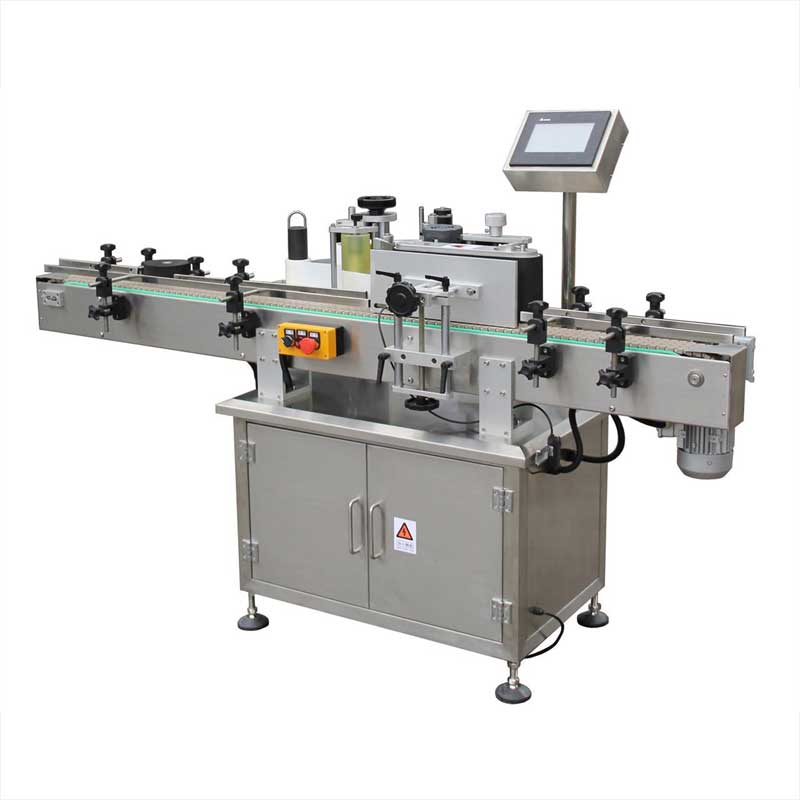
Container shape decides the machine
Most buyers search by industry. They look for a "food labeller" or a "cosmetics labelling machine." That framing leads them to the wrong machines. Container geometry is the actual decision variable.
Cylindrical containers, standard round bottles, jars, cans; use wrap-around label applicators. The container rotates against the dispensed label so it wraps the circumference evenly. This is the most common bottle labelling machine configuration and the most forgiving to automate. Consistent diameter across the label height produces clean, accurate wraps at a wide range of speeds.
Tapered containers, conical tubs, squeeze bottles with a pronounced shoulder taper, pails; introduce a diameter change from top to bottom. A flat rectangular label applied to a tapered surface wants to wrinkle or buckle at the edges. The machine needs custom support tooling that accounts for the changing diameter, and the label itself often needs to be designed with the taper in mind. Trying to run a tapered container on a standard wrap-around machine without the right tooling produces crooked, puckered labels regardless of how well the machine is calibrated.
Oval and flat-sided bottles cannot take a full wrap. The flat face of an oval bottle means the label ends where the geometry changes. These containers typically use front-and-back labellers — one applicator head for the front branding label, a second for the rear compliance label — applied in a single pass on the conveyor.
Flat packs, trays, and cartons use top labellers or top-and-bottom configurations. The product travels under the applicator head, which applies the label to the top surface. A top-and-bottom unit applies simultaneously to both faces — common where barcode and batch information sit on the underside while branding appears on the top.
Squeezable and deformable containers require controlled pressure during application. A rigid tamp or high-pressure wipe will deform the container at the point of contact, causing the label to wrinkle or bubble as the container springs back to shape. Applicators for flexible packaging use softer rollers or brush-down mechanisms and usually include support fixtures underneath the container to maintain shape during labelling.
The practical rule: name the geometry first, then choose the applicator type. Wrap, front-and-back, top, and top-and-bottom are the four core patterns. The industry you operate in is secondary.
Working out your throughput requirement
Convert your production volume to containers per minute before you speak to any equipment supplier.
Start with your annual volume and the number of hours per year you plan to run the labeller. Divide volume by hours, then divide again by sixty. That figure is your required sustained speed in containers per minute. Compare it against the throughput bands for each level of automation.
A producer running 400,000 units per year across 200 production days, with six labelling hours per day, needs a sustained rate of roughly five to six containers per minute. That falls comfortably within semi-automatic range. An automatic labelling machine at that volume is over-specification — higher capital cost, more complex changeovers, and no throughput benefit at typical production.
The same arithmetic applied at 2 million units per year across the same production schedule produces a required rate of roughly twenty-eight containers per minute. That number sits at the upper edge of semi-automatic capacity and the lower edge of automatic. The right answer depends on whether you want one operator fully dedicated to loading, or whether you need that person elsewhere on the line.
Peak demand is worth modelling separately, but it rarely justifies buying to the peak. A machine that runs at seventy percent of its rated capacity during typical production and at ninety percent during peak weeks is a better investment than one that runs at thirty percent most of the year.
Gulmen DigitalPlacement accuracy
Placement accuracy in label application has three components: registration along the direction of travel (how early or late the label starts), wrap alignment or skew (whether the label sits parallel to the container's axis), and lateral position (whether it lands centred on the intended panel).
What causes crooked labels? Inconsistent container handling is the most common root cause — bottles not seated firmly against guides, oval containers drifting laterally on the conveyor, or upstream spacing that varies enough to confuse the label sensor. Container variation compounds the problem: moulded bottles with off-centre seams or diameter tolerances wider than the label registration target will produce visible skew even on a well-calibrated machine.
Label roll quality matters more than most operators expect. A poorly wound roll telescopes as it unwinds, shifting the label edge relative to the sensor and producing a drifting placement pattern. Inconsistent die-cut position relative to registration marks adds cumulative error at speed.
The accuracy your product needs depends on what it carries and who buys it. A premium spirits bottle with an embossed label panel that must align to a moulded feature demands tight registration and probably orientation equipment upstream. A bulk household chemical container needs the barcode to scan and the regulatory text to be legible — a few millimetres of positional variation is irrelevant to the customer and to compliance. Over-investing in accuracy for a product that does not require it adds cost without adding value.
Integrating with an existing line
When you move from bench-top semi-automatic to inline automatic, fit to the existing line matters as much as the applicator itself.
Conveyor height and product flow direction are the first physical constraints. The labelling machine must marry to your current conveyor height or you rebuild sections of line around it. Check whether product flows left-to-right or right-to-left relative to the operator access side — getting this wrong turns every label change and jam clearance into an awkward reach.
Footprint defines what is possible in your plant. Measure the straight run available before and after the labelling zone. Automatic labellers need product spacing, timing screws, feed scrolls, or air gaps; to present one container at a time to the applicator head. That spacing equipment adds length before the label point.
Upstream and downstream equipment determines whether the labeller can run continuously. If the filler stops, the labeller must stop and restart cleanly without misapplying to the first container back on the belt. If a checkweigher or capper downstream backs up, the labeller needs the interlock to hold product rather than pile labels onto stationary containers. These are integration decisions, not applicator decisions, but they belong in the specification discussion from the start.
When automating pays
Rather than a payback figure, use a method.
Calculate the annual labour cost of your current labelling operation: operators dedicated to application multiplied by hours per week multiplied by weeks per year multiplied by fully loaded hourly cost. Add an estimate for rework — the time spent removing and replacing misapplied labels, scrapped containers, and any compliance exposure from incorrectly positioned regulatory panels.
Estimate the labour cost of the same operation after automation. A semi-automatic applicator typically reduces the head count for a given volume from two to one. A fully automatic system removes per-unit operator involvement entirely, replacing it with periodic supervision and changeover time.
The difference between those two annual figures is your annual saving. Compare it to the total cost of the equipment over a realistic period, purchase, installation, change parts, and maintenance; and the payback period becomes a calculation you own rather than one you borrowed from a supplier's marketing material.
The signals that you have already crossed the line worth automating: labelling regularly runs overtime to keep the line moving, staff are pulled from other tasks to cover application, customer complaints about label placement are increasing, or a new contract requires throughput your current method cannot sustain.
About Gulmen Digital
Gulmen Digital supports producers across Australia who have solved the printing side and are now confronting the application bottleneck. The company's capability spans digital print, label finishing, and label application equipment — bottle labelling machines, flat and carton applicators, and inline automatic label applicators — configured to match container geometry and line speed rather than fitted from a catalogue.
With more than twenty years operating in the Australian market, Gulmen Digital has built practical knowledge of the container formats, regulatory requirements, and production realities specific to local manufacturing. The company's Australian-developed Quantum platform underpins complete print-cut-finish solutions, allowing producers to move from artwork through printing, die cutting, and application as a single coordinated workflow rather than a sequence of disconnected vendor relationships. Support after installation covers operator training, performance tuning, changeover optimisation, and troubleshooting as products and line conditions evolve.
The practical starting point is a short discovery conversation. Gather your container samples, including the most geometrically challenging formats in your range; your current label artwork and sizes, your throughput data expressed as containers per minute at average and peak, and your existing line layout. Contact the Gulmen Digital team to map those inputs to the right applicator type and throughput band, and to build a business case grounded in your own production numbers rather than generic industry estimates.
Gulmen Digital — 1/42 Orbis Drive, Ravenhall VIC 3023 · (03) 9318 7177 · sales@gulmen.com.au · gulmendigital.com.au
Gulmen DigitalFAQ
What is the difference between a label applicator and a labelling machine? A label applicator is the mechanism that dispenses and places a label — the applicator head, peel plate, and drive. A labelling machine is the complete system: applicator plus conveyor, product handling, sensors, controls, and sometimes an integrated printer. In practice the terms are used interchangeably, but the applicator is technically one component of the machine.
How many containers per minute can an automatic applicator handle? Automatic systems span a wide range. The right number for your operation is whatever matches your conveyor line speed at sustained production, with a buffer for acceleration and minor line variation. Buying to the highest available speed rather than your actual requirement adds cost without adding throughput.
Can one applicator handle different bottle shapes? Many applicators adjust across a range of diameters and heights using guides and change parts. Switching between substantially different geometries, cylindrical to oval, for example; usually requires a different applicator configuration or additional tooling. Planning for your full product mix at the selection stage avoids costly retrofits later.
When is it worth automating label application? When the annual labour and rework cost of your current method exceeds the annualised total cost of the equipment. The signals that you are past that point: overtime is routine, staff are pulled from other tasks to cover labelling, or a new order requires throughput you cannot currently sustain.
What causes labels to be applied crooked? Inconsistent container handling, container geometry variation, poorly wound label rolls, incorrect sensor positioning, and mismatched conveyor and applicator feed speeds are the most common causes. Most can be resolved through better product guides, calibrated sensors, and label roll quality control. Persistent skew on tapered containers usually indicates a tooling mismatch rather than a machine fault.


Comments ()