
Label press or label printer: what actually differs
A label press is a production machine built to run continuously from roll to roll, with a defined duty cycle, calibrated colour management, and integrated finishing that converts blank stock into finished, application-ready label rolls in a single pass. A label printer prints labels — but it is not designed to do that all day, every day, across demanding substrates, with the finishing already done.
Marketing copy blurs those categories constantly. "Digital label press" and "label printer" appear on the same comparison pages, often describing machines that sit in completely different production classes. The confusion costs buyers time and sometimes money — they evaluate machines against criteria that don't match the job. This article draws the line precisely, using the five structural dimensions that separate the categories.
 Gulmen Digital
Printer or press — the difference
The cleanest distinction is operational: a label press is production equipment that belongs in a converting line, while a label printer is a device you use for a job. A press is designed around sustained throughput; a printer is designed around image output.
Five structural dimensions define the gap:
- Duty cycle — how much it can produce sustainably, not just in a burst
- Web width — the range of roll media it handles at production speeds
- Inline finishing — whether lamination, die cutting, matrix removal, slitting and rewinding happen inside the machine line or outside it
- Colour management — whether the system is calibrated for repeatable output across runs and substrates
- Substrate range — what materials it can reliably handle under production conditions
| Dimension | Label printer | Digital label press / industrial label press |
|---|---|---|
| Duty cycle | Designed for intermittent use; suited to short runs and occasional batches | Built for continuous, multi-shift production; sustained throughput is a core specification |
| Web width | Narrow; sized for small-format or shipping labels | Wider roll-fed webs; suited to full-colour brand labels across multiple lanes |
| Finishing | Mostly offline; cutting and laminating done on separate devices, if at all | Inline or tightly coupled: lamination, die cutting, matrix removal, slitting and rewinding in the same pass |
| Colour management | Driver-level colour; acceptable for logistics and internal labels | ICC-profiled workflows, calibrated hardware, spectrophotometric verification for batch-to-batch repeatability |
| Substrate range | Standard papers and a narrow selection of films | Broad range of pressure-sensitive papers, BOPP, PET, PP, specialty films and tag stocks |
| Run mode | Job-by-job, start-stop | Continuous roll-to-roll production |
| Typical use cases | Office labelling, shipping, occasional product labels | Brand product labels, food and beverage, cosmetics, industrial and chemical labelling |
The global digital label press market reached USD 7.2 billion in 2024 and is projected to grow at 10.8% CAGR to 2033 — faster than the broader label printer market — because converters are investing in equipment that can sustain production, not merely print labels.
Duty cycle and what it means
Duty cycle is the volume a machine is rated to produce reliably, shift after shift, without quality drift or excessive maintenance. It is not the peak speed shown on a spec sheet.
Most label press manufacturers publish two numbers: a maximum print speed (metres per minute) and a recommended monthly volume or duty rating. The maximum speed tells you what the machine can reach under ideal conditions. The duty rating tells you what it is designed to do over time. These two figures regularly differ, and buyers who focus on the first while ignoring the second end up running equipment outside its design envelope — which means more downtime, more consumable cost, and inconsistent output.
A production guide for digital label printing notes that most plants target 25–60 m/min for common SKUs; exact sustainable speed depends on ink coverage, substrate, and curing system.
The honest calculation is: realistic line speed multiplied by planned uptime, compared against your actual monthly label requirement.
In practical terms, the press-versus-printer line falls roughly here:
- Small business, occasional batches, few SKUs — a high-quality label printer handles the work without the overhead of a press-class system
- Growing brand, frequent reorders, many SKUs — a digital label press delivers the duty cycle and colour consistency that a printer cannot sustain
- Converter or contract packager, continuous multi-shift production — an industrial label press with appropriate finishing is the only viable option
When your volume pushes a desktop or office unit near its rated limit every month, you are already outside printer territory. The machine will tell you — through increased maintenance, colour inconsistency, and declining registration — before the spec sheet does.
Inline versus offline finishing
Finishing is the structural feature that turns a digital printer into a label printing press. When lamination, die cutting, matrix removal, slitting, and rewinding happen inline, in the same continuous pass as printing; the machine is producing finished, application-ready label rolls, not printed stock that needs further processing.
A roll-to-roll inkjet or toner system paired with a laminator, die cutter, and slitter becomes a complete label converting line, producing finished, cut, laminated, and rewound rolls from blank stock in a single workflow. That integration changes three operational realities:
Throughput improves because the job does not leave the line between steps. Each handoff between a printer and a separate finishing machine adds time, handling, and the possibility of registration error.
Labour drops. A press operator manages one production line. An equivalent printer-plus-finishing setup requires someone to move rolls between machines, set up each device separately, and manage the handoffs.
Floor space becomes a planning variable. A press is a production line component with a defined footprint and workflow position. A printer with offline finishing grows into a collection of separate machines that may or may not sit close together.
Offline finishing still makes sense in specific situations: low-volume operations where a printer handles daily output and a trade finisher or outsourced converter handles die cutting; or high-volume plants with dedicated, high-speed finishing lines that run faster than any single digital press could feed. For most growing label producers, the question is not whether they need finishing — they do — but whether it happens inline or in a second shift on a second machine.
 Gulmen Digital
Colour management and batch repeatability
There is a tension brand owners rarely hear stated plainly: peak colour quality and batch repeatability are different things, and for a label buyer, repeatability is almost always more valuable.
A printer can produce a visually impressive label on a single run. The question that matters is whether the label printed six months later, on a different roll of the same substrate, looks identical on shelf. Shelf inconsistency is visible to consumers and damaging — a product line where some bottles look different from others signals poor quality whether or not the labels are technically within tolerance.
Packaging Impressions defines the distinction precisely: consistent colour means colour that does not deviate during a press run once you achieve an accurate match to your target; repeatability means you accurately achieve those targets on every press run.
Consistency within a run is necessary, but brand equity depends on repeatability across runs, substrates, and time.
Press-class systems achieve this through managed workflows: ICC profiles built for each substrate, calibration routines on a defined schedule, and in-run measurement using spectrophotometers. Global Graphics' white paper on colour management for digital label presses treats the entire system, press, ink, substrate, RIP, and measurement; as a single controlled unit. That is what colour management means at press level, and it is structurally different from driver-level colour adjustment on a desktop printer.
For label buyers, the practical implication is straightforward: if brand colour consistency across reorders is a business requirement, it belongs on a press, not a printer.
Substrate range — where the machine meets its limit
Substrate range is often the deciding factor that forces a decision between printer and press, even when volume alone does not.
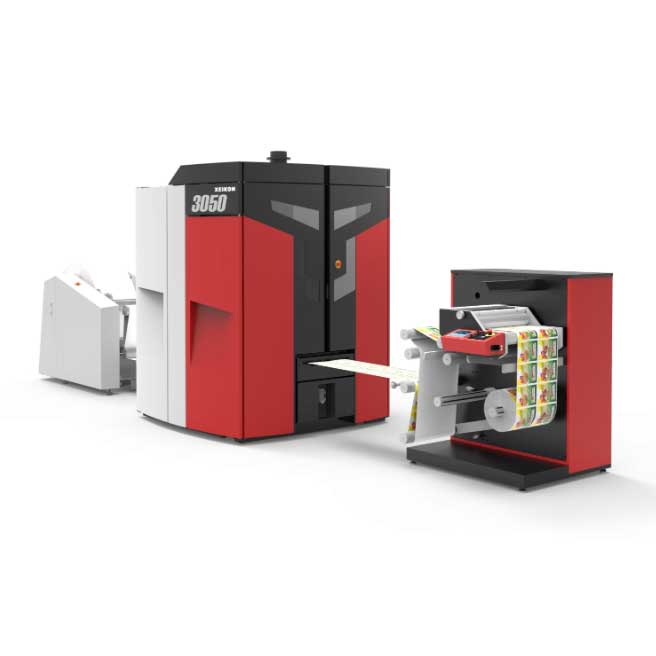
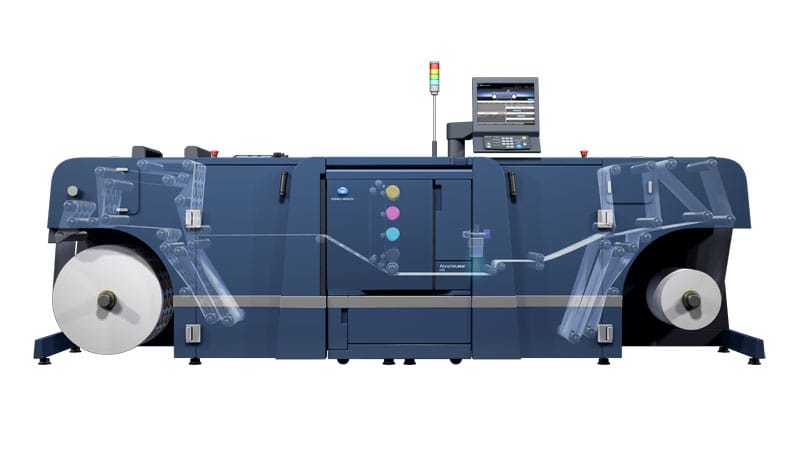
Press-class digital label presses support a documented range of pressure-sensitive papers, BOPP, PET, PE, and specialty films, validated by the manufacturer for specific ink and curing combinations. Mark Andy's Digital One, for example, explicitly lists pressure-sensitive papers, BOPP, PET, PP, unsupported papers, and tag stocks, often without priming or pre-coating. Konica Minolta's AccurioLabel platform supports plain paper, special paper, and transparency films. The key word is validated — a press comes with a substrate matrix that defines what it can reliably produce, not just what it can physically feed.
Label printers, particularly desktop and office models, handle a narrower selection of vendor-approved materials. They can often feed non-approved stocks, but adhesion, durability, and colour stability outside that range are unpredictable. For logistics and internal labels on standard papers, that is a non-issue. For food and beverage labels on BOPP, chemical labels on polyester, or cosmetics labels on metallised films, the substrate forces the conversation into press territory.
Which class your production needs
Work through this checklist before evaluating machines:
- Monthly label volume and duty cycle — calculate realistic monthly label metres, not a peak number. If a desktop unit would run near its rated duty cycle every month, you need press-class equipment.
- SKU count and changeover frequency — many SKUs with frequent design changes favour digital label presses, which switch jobs without plates or tooling changes.
- Substrate requirements — if your product labels use films, synthetic materials, or specialty stocks, verify that the equipment you are evaluating has a validated substrate matrix that includes them.
- Finishing complexity — if labels need to be die cut, laminated, and slit to finished rolls, decide now whether that happens inline or offline, and factor the cost of the second option.
- Colour tolerances — if brand owners or retailers specify colour tolerances across reorders, you need a calibrated, ICC-profiled press workflow.
- Operational capacity — floor space, staff skills, and shift structure all affect whether a press makes sense. A press is not a device you install in a corner; it is a production line that requires planning.

About Gulmen Digital
Gulmen Digital has spent over 20 years in the Australian label and packaging market, and that depth shows in how they approach a customer conversation — not by matching a product to a query, but by mapping equipment class to actual production requirements. They supply both label printers for lighter-duty applications and digital label presses for production environments, which means their advice starts with an honest assessment of where a customer's operation sits on the press-versus-printer spectrum.
At the press level, Gulmen Digital's portfolio includes roll-to-roll digital label presses with integrated finishing options — systems built to combine printing with inline lamination, die cutting, and slitting so that finished rolls exit the line ready for application. Central to their digital label capability is the Australian-developed Quantum platform, a modular digital print engine designed for label and packaging production, with flexibility for different substrate requirements and finishing configurations. The Quantum platform is not an imported product repackaged for the Australian market; it was developed here, for the conditions and requirements that Australian manufacturers and converters face.
Support after installation is where Gulmen Digital's model differs from many equipment vendors. A press purchase is a workflow decision, and the ROI depends on achieving the machine's rated duty cycle, maintaining colour calibration, and running it on the correct substrates with the right finishing configuration. Gulmen provides installation, training, colour management setup, and ongoing maintenance — the elements that determine whether a press performs in production rather than just in a demonstration. Businesses assessing the move from printer-class to press-class equipment are encouraged to prepare a production profile, monthly volumes, SKU count, substrate mix, and finishing requirements; and bring that to a conversation with Gulmen Digital rather than evaluating machines in isolation.
Gulmen Digital — 1/42 Orbis Drive, Ravenhall VIC 3023 · (03) 9318 7177 · sales@gulmen.com.au · gulmendigital.com.au
Gulmen DigitalFAQ
What is the difference between a label printer and a label press? A label printer is a device for intermittent, lower-volume label work with limited substrates and little or no inline finishing. A label press is industrial, roll-to-roll production equipment designed for sustained duty cycle, calibrated colour management, broader substrate support, and integrated finishing that delivers finished label rolls in a single pass.
What does duty cycle mean for a label press? Duty cycle is the volume a press is engineered to produce sustainably — typically expressed as continuous metres or monthly impressions under real shift conditions — rather than its theoretical maximum speed. Choosing equipment based on peak speed rather than duty cycle is how operations end up running machines outside their design range.
Do you need inline finishing? You need inline finishing when labels must exit the production line already die cut, laminated, and slit onto finished rolls for automated application. Offline finishing is viable for low-volume operations or where a separate high-speed finishing line is already in place, but it adds handling, time, and labour per finished roll.
What substrates can a digital label press print? Modern digital label presses support a validated range of pressure-sensitive papers, BOPP, PET, PP, and specialty films, depending on the print engine and ink or toner system. The critical step is checking the manufacturer's substrate validation matrix for the specific materials your application requires — not just whether the substrate can physically feed through the machine.
When does a business need a press rather than a printer? A business needs a press when label production becomes a continuous operational requirement: regular high-volume runs, many SKUs with frequent reorders, demanding substrates, complex finishing, and brand colour consistency across batches. When those conditions apply, running on printer-class equipment creates risk in uptime, quality, and cost per label.

Comments ()